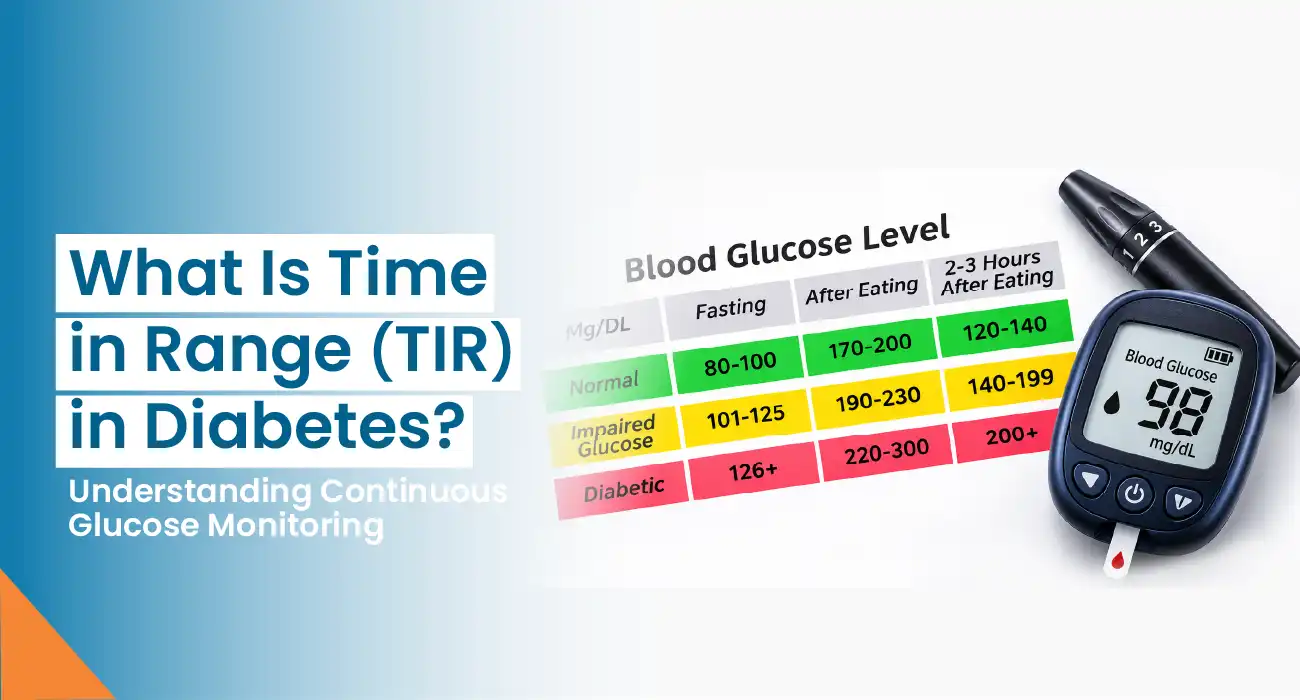
What Is Time in Range (TIR) in Diabetes? Understanding Continuous Glucose Monitoring
11/12/2026
Managing diabetes is not just about keeping your average blood sugar levels under control. It is also about being aware of how often your glucose levels go too high or too low throughout the day. This is where Time in Range (TIR) in diabetes comes into play.
Time in Range (TIR) is a measurement that individuals with diabetes and diabetologists/endocrinologist use to assess their diabetes management. A recommended target range is usually between 70 and 180 mg/dL for most adults with Type 1 or Type 2 diabetes.
TIR is commonly measured using a Continuous Glucose Monitor (CGM), which tracks your glucose (sugar) levels in real time. There are general guidelines for TIR goals, but you may have different goals based on your unique situation.
Read this blog to understand the time in range meaning, recommended targets, how CGM works, and the importance this measurement holds for better diabetes management.
What Is Time in Range (TIR) in Diabetes?
TIR is the amount of time a person with diabetes spends in a target blood sugar (glucose) range.
For most (but not for everyone) adults with Type 1 or Type 2 diabetes, that’s between 70 and 180 mg/dL.
TIR is measured as a percentage. For example, if your TIR is 70%, it means your blood sugar remained within the target range for approximately 17 hours out of a 24-hour day. The remaining 7 hours may include periods when your glucose levels are either too high or too low.
Why TIR in Diabetes Matters
TIR helps healthcare professionals improve blood sugar management.
They use TIR data to understand glucose patterns, identify fluctuations, and make informed decisions about diabetes management.
Time-in-range has emerged as a valuable blood glucose metric, ‘beyond HbA1c’, for deeper insight into keeping blood glucose levels within a safe range in individuals with high blood sugar levels.
Recommended Diabetes Time in Range Target
For most adults with Type 1 or Type 2 diabetes, the general recommendation is to spend at least 70% of the day within the 70–180 mg/dL range.
But your ideal diabetes time in range target may vary based on your age, health conditions, pregnancy status, diabetes duration, and risk of hypoglycaemia (low blood sugar).
Here are the commonly recommended TIR targets for most adults:
| Blood glucose range* | Classification | Recommended time |
| Below 54 mg/dL | Very low | Less than 1% |
| 54–69 mg/dL | Low | Less than 4% |
| 70–180 mg/dL | In range | More than 70% |
| 181–250 mg/dL | High | Less than 25% |
| Above 250 mg/dL | Very high | Less than 5% |
* These targets are general guidelines. Your diabetologist in Jaipur can help determine a safe and realistic target based on your individual factors.
How Does Continuous Glucose Monitoring (CGM) Help Calculate TIR?
CGM is a wearable device that tracks your blood sugar levels over time.
A CGM generally consists of:
A Sensor Just Under Your Skin
A small device placed on or under the skin that measures glucose in the interstitial fluid (fluid found in the spaces around cells).
Transmitter
Sends results to a wearable device or cell phone so you can track changes to your glucose level in real time.
Display Device or App
Shows glucose readings, trends, graphs, and alerts.
Unlike traditional blood sugar monitoring, which generally requires finger-prick tests at specific times, CGM gives continuous glucose information while you wear the sensor.
The CGM wearable device helps you understand how your blood sugar responds to different activities throughout the day and night, such as eating, exercising, sleeping, taking medication, and experiencing stress.
What Does a CGM Time in Range Report Show?
Most CGM systems present TIR information with the help of colour-coded graphs or reports.
These reports divide glucose readings into different categories, making them easier to understand.
You may see:
- Green: Glucose levels within the target range.
- Yellow or orange: Glucose levels above or below the target range.
- Red: Very high or very low glucose levels.
Time in Range vs. HbA1c: What is the Difference?
Both TIR and HbA1c help assess diabetes management, but they give different information.
A haemoglobin A1C (HbA1C) test is a blood test that shows your average level of blood sugar over the past two to three months.
TIR shows how your glucose levels fluctuate over shorter periods, including daily highs and lows.
| Parameter | Time in Range (TIR) | HbA1c |
| What it measures | Percentage of time glucose stays within the target range. | Average blood glucose. |
| Measurement period | Hours to days, depending on the CGM report. | Approximately 2–3 months. |
| How it is measured | Primarily through CGM. | Blood test. |
| Glucose fluctuations | Shows highs and lows. | Does not show daily fluctuations. |
| Main benefit | Helps identify glucose patterns. | Helps assess longer-term glucose control. |
Can People Without Diabetes Use a CGM?
CGMs are primarily for people with diabetes. But a doctor may recommend CGMs for other conditions that impact sugar levels, like:
- Prediabetes.
- Obesity.
- Certain glycogen storage diseases, which can cause frequent low blood sugar episodes.
- Insulinoma, a rare tumour that releases excess insulin.
Talk to your healthcare provider if you think a CGM may benefit your health.
What are the Limitations of CGMs?
Like all other technologies, CGM systems can run into issues, be inaccurate or fail.
Certain medications and supplements can also affect the accuracy of certain CGM sensors such as acetaminophen, hydroxyurea, a medication for sickle cell anaemia, and vitamin C (ascorbic acid).
Some things that you may see as drawbacks of CGMs include:
- Cost
- Information overload
- Alarm fatigue
- It’s always attached to your body
- Allergic reactions to the skin adhesives CGM devices use
FAQs About Time in Range (TIR) in Diabetes
Does TIR replace HbA1c?
No.
TIR is not a replacement for HbA1c. Both measurements give useful insight and complement each other for diabetes management. HbA1c helps assess long-term glucose control; TIR provides a comprehensive picture of daily glucose variations.
Why is time in range important for people with diabetes?
Here are some important benefits:
- Helps identify blood sugar fluctuations
- Helps reduce the risk of hypoglycaemia
- Supports better diabetes management
- May help reduce diabetes-related complications (diabetic retinopathy, neuropathy, and cardiovascular problems)
However, more long-term research is required to establish how improvements in TIR directly affect the development and progression of these complications.
How can you improve your time in range?
Here are some steps to discuss with your healthcare provider:
- Follow a balanced diet
- Stay physically active
- Take medications as prescribed
- Monitor glucose patterns
- Manage stress and sleep
- Attend regular check-ups
Conclusion
Time in range provides you and your doctor a more accurate look at the glucose fluctuations that come with diabetes. It is an important addition to modern diabetes management because it helps you understand more than just your average blood glucose levels. It shows how frequently your glucose stays within, above, or below the target range for making informed treatment decisions.
Continuous Glucose Monitoring makes tracking these patterns easier and helps doctors personalise diabetes care. However, TIR should always be interpreted alongside HbA1c, medical history, and other relevant health parameters.
When to Consult a Diabetologist/ Endocrinologist in Jaipur
If you are finding it difficult to manage your blood glucose levels, consult an experienced diabetes doctor in Jaipur. A qualified diabetes doctor can evaluate your glucose patterns, recommend suitable blood sugar monitoring methods, and guide you towards an appropriate diabetes treatment plan.
Who Should Use a Continuous Glucose Monitor?
CGM can be useful for people with type 1 and type 2 diabetes, especially those using insulin or treatments that may cause hypoglycaemia. It may also benefit some individuals who are not using insulin. Your diabetologist/ endocrinologist in Jaipur can help determine whether CGM is appropriate for your condition.
Disclaimer: This blog is for informational purposes only. For accurate information about Time in Range (TIR) in diabetes, contact your diabetologist.
Medical reference sources for fact-checking:
- Cleveland Clinic – Time in Range (TIR) for Diabetes
- Saboo B, et al. – Time-in-range as a target in type 2 diabetes: An urgent need
- American Diabetes Association – CGM and Time in Range
- Endocrine Society – Time-In-Range and Diabetes
Written and Verified by: