



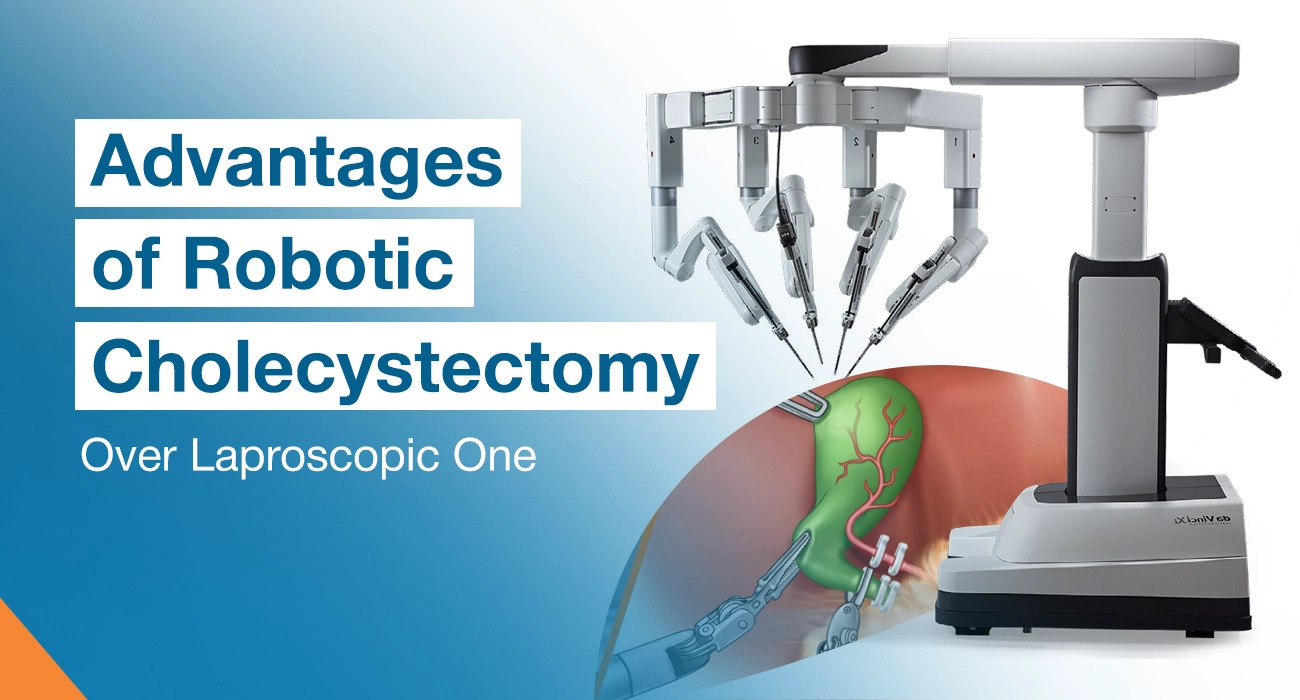
Advantages of Robotic Cholecystectomy Over Laparoscopic One
12/26/2025
Cholecystectomy, or Surgical removal of the Gallbladder, used to be performed using a conventional open surgical approach until the early 1990s, when laparoscopic surgery was swiftly accepted due to its numerous advantages over Open Surgery.
Now, three decades later, a revolutionary approach for gallbladder removal, robotic cholecystectomy, is gaining acceptance among surgeons at a very fast pace. This is because it provides numerous advantages over the traditional Laparoscopic technology, resulting in better clinical outcomes and minimal invasion of tissues. Let's scroll down and learn more about how Robot-Assisted Surgery is transforming cholecystectomies in the current scenario.
Read Also: Everything You Need to Know About Robot-Assisted Surgery for Gall Stone Disease
What is Cholecystectomy ?
A Cholecystectomy is a procedure that involves the Surgical removal of the Gallbladder. The Gallbladder is a pear-shaped organ positioned directly below the liver on the upper right side of the abdominal cavity. The function of the Gallbladder is to collect and store bile, a digestive fluid produced by the liver. Cholecystectomy is a common and safe procedure, as it is associated with a low risk of complications.
When Is Cholecystectomy Recommended ?
A Cholecystectomy is commonly performed to treat Gallstones and the associated complications. Your doctor may advise a Cholecystectomy if Gallstones in the Gallbladder are causing severe symptoms.
The following are the indications:
- Cholelithiasis (gallstone inside the gallbladder)
- Choledocholithiasis (gallstones in the bile duct)
- Cholecystitis (inflammation or infection of the gallbladder)
- Gallbladder polyps that can potentially turn cancerous
- Pancreas inflammation
- Concern for gallbladder cancer
Myths & Facts Associated With Robotic Cholecystectomy
Despite initial skepticism, Robotic and Laparoscopic Cholecystectomies have now transformed General Surgery and established themselves as the gold standard. The field of Minimally Invasive Surgery is now seeing the introduction of new Robotic technologies.
Myths
The Robotic Cholecystectomy (RC) procedure was associated with misconceptions like being a time-consuming alternative to Laparoscopic Cholecystectomy (LC). It is also believed that Robotic Cholecystectomy yields clinical outcomes that are almost similar to the Laparoscopic one. It is also considered an expensive alternative to Laparoscopic Cholecystectomy.
Facts
But this is a biased perception based on much of the previous research on this treatment, which was done when it was still in its earliest stages of research. Robotic cholecystectomy can be performed cost-effectively depending upon the circumstances. Furthermore, increased visibility and the ability to perform fluorescence cholangiography (an imaging technique used during gallbladder surgery to enhance the precision of the procedure) can elevate the safety profile of cholecystectomy to levels not previously obtained with traditional laparoscopy.
The introduction of advanced simulation technology for robotic surgery for better training and upscaling the precision, as well as newer single-site robotic systems (surgery with a single small incision), has the potential to transform the field and increase patient satisfaction. This is elevating the success of the clinical outcomes as well as lowering the chances of complications in comparison to laparoscopic procedures.
Advantages of Robot-Assisted Cholecystectomy Over Laparoscopic & Open Approaches
Robotic Surgery vs Laparoscopic Surgery:
| Specification | Robot-Assisted Cholecystectomy | Laparoscopic Cholecystectomy | Description |
| Magnification | Up to 10× magnification | Around 2–3× magnification | Robot-assisted cholecystectomy provides much clearer 3D vision and higher magnification than laparoscopic surgery, allowing surgeons to operate with greater precision. |
| Vision | 3D, high-definition, immersive vision | 2D vision (limited depth perception) | |
| Precision & Control | Extremely high; tremor filtration and scaled movements | Good, but limited by rigid instruments | Robotic surgery allows surgeons to filter hand tremors and make finer movements, which is not possible in conventional laparoscopy. |
| Instrument Wrist Movement | 540° articulated robotic wrist movement | No wrist articulation (0°) | Robotic instruments can bend and rotate like a human wrist, while laparoscopic instruments are rigid and have limited movement. |
| Degrees of Freedom | 7 degrees of freedom | 4 degrees of freedom | |
| Ergonomics for Surgeon | Excellent; the surgeon operates seated at the console | Moderate; physically demanding | Poor; physically strenuous |
| Port Size | 8 mm ports | 5–10 mm ports | Robotic surgery typically uses smaller ports, resulting in better cosmetic outcomes. |
| Port-Site Pain | The pain at the port site is minimal because of the precision of the procedure and the reduced trauma to surrounding tissue. | Mild to moderate | Robotic cholecystectomy generally causes less tissue trauma and less pain compared to laparoscopic surgery. |
Why Choose Eternal Hospital for Robotic Cholecystectomy ?
As one of Jaipur’s leading surgical care facilities, Eternal Hospital is equipped with state-of-the-art robotic surgical systems, including the advanced da Vinci Xi technology. This distinguishes the hospital as a center of excellence in Jaipur for performing minimally invasive procedures, with a strong track record of successful outcomes—even in complex cases.
Supported by a team of highly trained hepato-pancreato-biliary (HPB) surgeons experienced in advanced robotic techniques, Eternal Hospital offers comprehensive, high-quality surgical care. Together, this expertise and technology make the hospital a trusted choice for improving quality of life after both simple and complex surgical procedures.
Conclusion
With the advent of robotic technology in cholecystectomy care, patient comfort and treatment outcomes have improved significantly. The introduction of da Vinci Xi–assisted robotic cholecystectomy has marked a major advancement in gallbladder surgery. Leading gallbladder surgery centers in Jaipur, such as Eternal Hospital, have been at the forefront of adopting this technology, achieving high success rates with minimal patient discomfort.
At every stage of your treatment journey, from diagnosis to recovery, our committed team is here to support you. Get personalized advice from the top gallbladder surgeons in India at Eternal Hospital. Book your consultation now!
FAQs
Q1: What are the benefits of Robotic Cholecystectomy?
A: As with other Minimally Invasive procedures, Robotic-Assisted Cholecystectomy supports high precision, reduced discomfort, less bleeding, shortened hospital stays, and expedited recovery periods.
Q2: Would it be possible to lead a normal life following a Cholecystectomy ?
A: Yes, the majority of individuals lead entirely normal and healthy lives without a Gallbladder, as the liver assumes responsibility for bile production. However, you may need to make temporary dietary modifications, particularly concerning rich foods, as your body adapts to the direct passage of bile into the intestine.
Q3: Is Robotic Gallbladder removal painful ?
A: Cholecystectomies are typically carried out under General Anesthesia, ensuring that patients remain unconscious throughout the procedure. The smaller incision results in less pain compared to a larger one from Laparoscopic or open methods.
Written and Verified by:

Dr. Kapileshwar Vijay
Director and HOD - Robotic GI Surgery, Minimal Invasive Surgery
Meet the doctor