



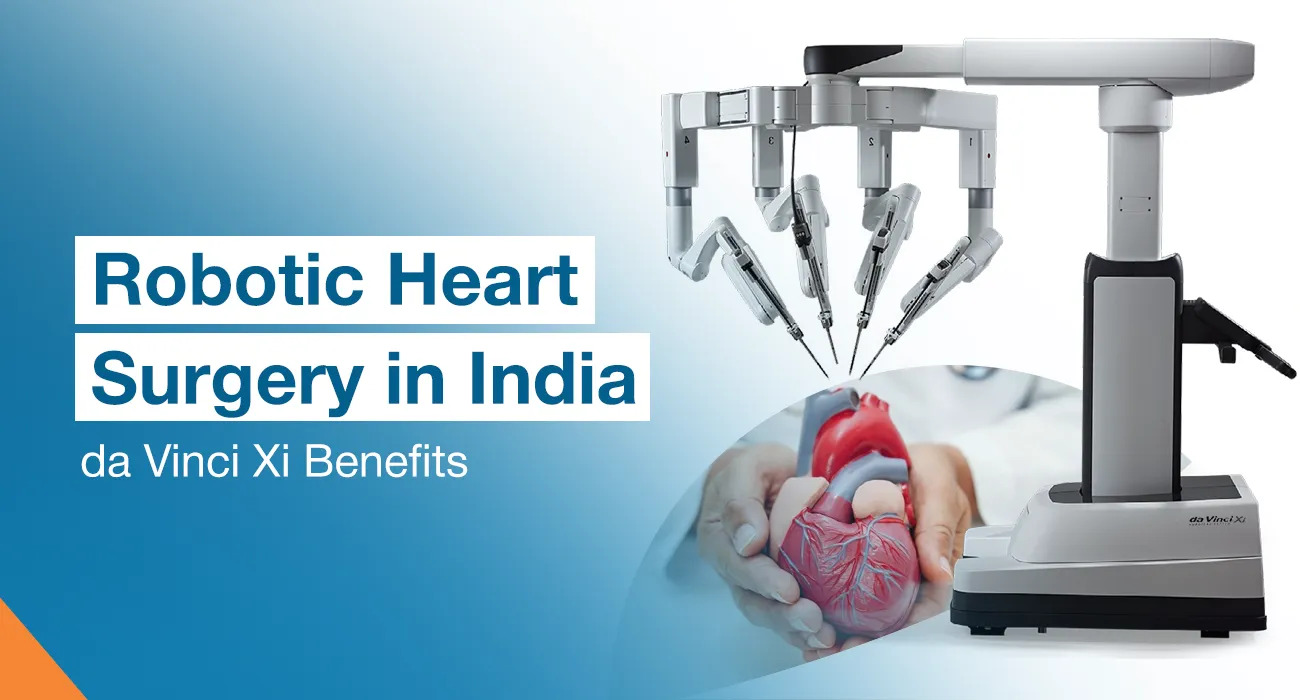
Robotic Heart Surgery in India: Benefits of da Vinci Xi for Complex Cardiac Conditions
03/25/2026
Think of your expensive luxury watch; in case there is any defect, if you try to fix the delicate gears present inside the watch with large tools. What will happen? Chances are, even a small movement mistake could cause significant damage. But when the same defect is fixed by a watchmaker through precision instruments, they can fix even the smallest parts without disturbing the rest of the system.
Similarly, your heart is just delicate and complex; earlier doctors had to rely on traditional open-heart surgery to repair heart problems that required large incisions. Thankfully, today, medical technology has evolved dramatically; technologies like the da Vinci Xi are allowing surgeons to operate on the heart via minimal incision, supporting faster recovery and fewer complications.
But this does not mean traditional open-heart surgery does not have a role to play; it is still important in certain cases when other tools aren't enough. Only your cardiologist will decide the best treatment technique for you based on the severity and type of your heart condition.
Read Also: Robotic Surgery - How can it make a difference?
What is da Vinci Xi Surgery?
It is a specific type of robot-assisted surgery that surgeons use to do a wide range of procedures, including urological, colorectal, and thoracic surgeries.
It consists of three or four robotic arms that hold surgical instruments and an endoscopic camera, allowing your surgeon to see inside your body.
These instruments fit through small incisions, eliminating the need for larger incisions, like the ones experts make in traditional “open” surgeries.
The U.S. Food & Drug Administration approved the da Vinci robot for surgical use in July 2000. It got its name from Leonardo da Vinci’s study of human anatomy.
Read Also: When Is Robotic Hysterectomy Recommended? Conditions & Eligibility Surgery
The 3 Main Components of da Vinci Surgical System®
It consists of three primary components:
1. Control Center “The Command Center”
Your surgeon sits here during the operation. The screen here provides them with high-definition, 3D views of the surgical site and magnified images of the anatomy, and enables them to control the robotic arms.
2. Patient Cart
This cart is placed next to the patient during the operation. It holds the instruments, the endoscope (camera), and any necessary instruments for the procedure.
3. Vision Cart
This unit contains the hardware and software crucial to operating the da Vinci surgical robot. This cart processes the images, facilitates communication between all components, and supports the 3D high-definition vision system.
Read Also: Robotic Surgery in Prostate Cancer: Benefits, Precision & Recovery Time
What Surgeries Can be Performed With the Help of da Vinci Robot?
Surgeons use this robotic heart surgery for many procedures across different specialties, including:
- Colostomy
- Endometrial ablation
- Mitral valve repair
- Polypectomy
- Splenectomy
- Tonsillectomy
- Gallbladder removal
- Gastric sleeve surgery
- Gastrotomy (feeding) tube placement
- Hysterectomy
Key heart conditions treated with the da Vinci robot include:
- Mitral valve disease
- Coronary artery disease
- Atrial septal defect (ASD)
- Heart tumors
- Arrhythmias
- Tricuspid valve repair
- Pericardiectomy
Read Also: Everything You Need to Know About Robot-Assisted Surgery for Gall Stone Disease
Advantages of da Vinci Xi for Complex Cardiac Conditions
Cardiologists at top heart care centers like Eternal Hospital use the da Vinci Xi for complex cardiac conditions because of the following benefits:
1. Minimally Invasive Surgery
Unlike traditional open surgery, it creates only small incisions.
This means:
- Less trauma to the body
- Reduced blood loss
- Lower risk of infection
2. Improved Precision and Control
The robotic instruments integrated into the da Vinci Xi system have a wider range of motion than the human hand.
The system filters out natural hand tremors, offering steadier and more controlled surgical movements. This means a surgeon can perform highly delicate movements in a smooth manner.
3. High-Definition 3D Visualization
It offers a more detailed view of internal organs (a three-dimensional view of the heart) than what surgeons see with the naked eye. This helps lower the risk of complications.
4. Faster Recovery
Lesser incision means:
- Shorter hospital stays
- Quicker healing of incisions
- An individual can return to daily activities in a faster manner
5. Lesser Scarring
No large scar across the chest with the help of minimal incisions.
6. Lower Risk of Complications
Lower rate of infection, wound healing issues, and other post-op risks.
Read Also: Robotic Hernia Repair: Faster Recovery, Less Pain & Better Outcomes
da Vinci Xi vs. Traditional Open Surgery
| Benefit | da Vinci Xi | Traditional Open Surgery |
| Incision Size | 1-2 cm ports | 20-25 cm sternotomy |
| Recovery Time | 1-2 weeks | 6-12 weeks |
| Blood Loss | 200-500 ml | 1-2 liters |
| Approximate Cost in India | ₹4-7 lakhs | ₹5-10 lakhs |
| Complication Rate | 2-5% | 10-20% |
Read Also: All You Need to Know About Robotic Radical Hysterectomy
Why Choose Eternal Hospital for Robotic Heart Surgery with da Vinci Xi in India?
Eternal Hospital is the leading center in robotic cardiac care, backed by the advanced da Vinci Xi system for minimally invasive procedures.
Here is what helps us stand out:
- Expert surgeons
- Affordability
- Awarded the gold seal by JCI
- Affiliated with Mount Sinai Hospital
- Facilitated with ACC for excellence in heart care
- Accredited with NABH for strict adherence to quality
- Accredited with NABL for testing and calibration laboratories
- Short wait times
- Holistic care
Looking for minimally invasive solutions to address a heart condition?
Get expert advice on the advanced treatment available by calling us at +91-9549158888.
FAQs
Q1: What is the da Vinci Xi system?
A: It is an advanced, robotic-assisted, minimally invasive surgical method that is available in healthcare institutions like Eternal Hospital.
Q2: Is the da Vinci Xi system safe?
A: Yes, it is generally considered safe, reliable, and FDA-cleared for many minimally invasive procedures.
Q3: What are the risks of the da Vinci Xi system?
A: It is generally considered safe, but like any surgical technology, it can lead to complications like
- Longer operative time.
- Infection at the incision sites or inside the chest/abdomen.
- Instrument problems, such as breakage and shedding of small pieces.
- It is more expensive
- It is more technically demanding.
- Breathing problems and heart complications due to anesthesia.
Written and Verified by:
