



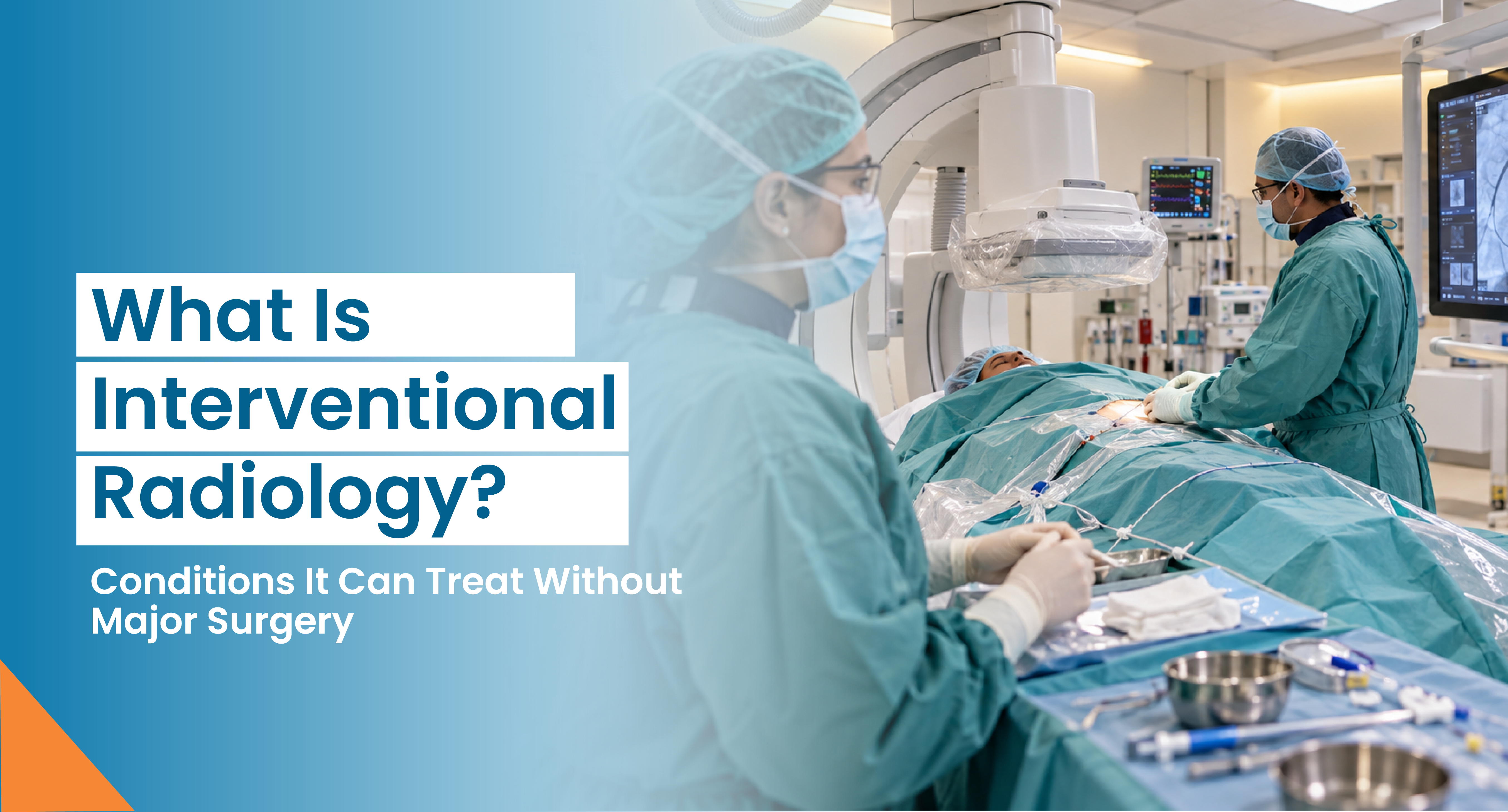
What Is Interventional Radiology? Conditions It Can Treat Without Major Surgery
07/21/2026
Interventional radiology (IR) is a medical specialty or branch of radiology that employs minimally invasive (uses tiny incisions instead of major surgery), image-guided procedures (such as ultrasound, CT scans, X-rays, and MRI) for the diagnosis and treatment of conditions, such as abdominal masses.
These minimally invasive procedures are performed by a specially trained interventional radiologist.
These procedures allow individuals to:
- recover faster
- experience less pain
- often avoid long hospital stays
Think it like this way:
Traditional surgery is like opening an entire wall to fix a leaking pipe. On the other hand interventional radiology is like using a small inspection hole and specialized tools to fix the exact problem without damaging the rest of the wall. That’s why IR is one of the fastest-growing fields in modern medicine.
What Is Interventional Radiology Used for
IR uses advanced imaging such as X-rays, CT scans, and ultrasounds, to carry out minimally invasive procedures.
What is the Goal of IR
- The goal is very simple:
- Treat the disease with maximum precision
- Minimize damage to healthy tissues
- Lower recovery time
- Decrease the risk of complications
How Does Interventional Radiology Work?
Every IR treatment follows a very basic principle: “see carefully before you treat.”
Here are the 5 basic steps that are in the IR procedures follows:
Step 1 Real-Time Imaging
CT, ultrasound, MRI, or fluoroscopy is used to identify the target area.
Step 2 Access
A tiny needle or catheter is inserted through a small skin puncture.
Step 3 Navigation
Imaging guides instruments (such as fluoroscopy or ultrasound) guide doctor in real time to navigate the tools and monitor the treatment safely to the targeted site.
Step 4 Treatment
Medication, heat, cold, balloons, stents, or embolic agents are used to treat the condition.
Step 5 Recovery
In most cases recovery is much faster than after traditional surgery.
Does Interventional Radiology Have a Future?
Yes.
In fact, its demand is growing faster because of its less invasive but equally effective nature.
Some IR procedures are even performed as outpatient treatments. This allows patients to return home the same day.
What Conditions Can Interventional Radiology Treat?
Interventional radiologists do a variety of IR procedures, including:
| Condition | Name of the IR Procedure |
| Blocked arteries | Angioplasty, stenting |
| Blood clots | Thrombolysis, thrombectomy |
| Internal bleeding | Embolization |
| Liver tumors | Chemoembolization, radioembolization, ablation |
| Kidney tumors | Ablation, biopsy |
| Lung nodules | Image-guided biopsy |
| Enlarged prostate | Prostate artery embolization |
| Uterine fibroids | Uterine artery embolization |
| Fluid around lungs | Thoracentesis |
| Abdominal fluid (ascites) | Paracentesis |
| Feeding difficulties | Gastrostomy tube placement |
| Vertebral fractures | Kyphoplasty, vertebroplasty |
| Chronic knee pain | Genicular artery embolization |
Is Interventional Radiology Used in Cancer Treatment?
Yes.
Interventional Radiology (IR) is referred to as interventional oncology.
But IR does not replace cancer surgery, it often works alongside:
- Chemotherapy
- Radiation therapy
- Immunotherapy
- Surgery
Examples include:
- Tumor biopsies
- Liver tumor embolization
- Tumor ablation
- Pain relief procedures
- Drainage of fluid caused by cancer
- Placement of chemotherapy ports
What Are the Benefits of Interventional Radiology?
When compared to traditional surgery, many minimally invasive procedures used in IR provide offer many advantages.
Interventional Radiology vs. Traditional Surgery Benefits
| Interventional Radiology Benefits | Traditional Surgery Benefits |
| Tiny incision | Large incision |
| Less blood loss | Higher blood loss |
| Lower infection risk | Higher infection risk |
| Faster recovery | Longer recovery |
| Shorter hospital stay | Longer hospitalization |
| Less pain | More postoperative pain |
| Minimal scarring | Larger scars |
If you are wondering “Is interventional treatment better than surgery?” Neither is universally better because both have their own advantages.
Only doctor can decide the best option for you based on:
- Overall health
- Medical history
- Imaging findings
- Severity of disease
- Treatment goals
Who Is a Good Candidate for Interventional Radiology?
Not everyone qualifies for IR procedures. You may be a candidate if you have:
- Blocked blood vessels
- Blood clots
- Liver disease
- Certain cancers
- Kidney tumors
- Lung nodules
- Chronic pain
- Internal bleeding
- Enlarged prostate
- Uterine fibroids
- Difficulty swallowing requiring feeding tube placement
Consult the best interventional radiologist at Eternal Hospital to determine the best approach for you.
FAQs
What are the risks of interventional radiology?
No medical procedure is completely risk-free.
Here are the potential risks:
- Bleeding
- Infection
- Allergic reaction to contrast dye
- Damage to nearby blood vessels
- Blood clots
- Temporary pain or swelling
Who performs interventional radiology procedures?
Only a specially trained interventional radiologist performs IR procedures.
These physicians complete:
- Medical school
- Diagnostic radiology residency
- Additional fellowship training in interventional radiology
- Board certification
Interventional radiologist work in collaboration with surgeons, oncologists, cardiologists, vascular specialists, nephrologists, and primary care physicians to offer personalized treatment.
Is interventional radiology safe?
Yes.
When performed by trained specialists, IR is known for lower risk and faster recovery.
How long does it take to recover from interventional radiology?
Within 24 to 48 hours, most patients are able to resume light daily activities.
However, full recovery may take several weeks to months, depending on the procedure and individual factors.
Conclusion
Interventional radiology is expected to play an even greater role in delivering safer and more personalized care in future.
IR is allowing doctors to perform procedures that once required major surgery via tiny incisions. This is enabling faster recovery and fewer complications. However, not everyone if the right candidate. Consult the best interventional radiologist to know the best approach for you.
Looking for the best interventional radiologist in Jaipur?
Contact Eternal Hospital, our major advancements in interventional radiology help our experts in early detection of cancer, tumor, blockage in arteries or veins, liver issues, fibroids, and other bodily problems.
Interventional radiology procedures at Eternal Hospital include:
- Angioplasty
- Cancer treatment
- Tumor ablation
- Biopsy
- Nephrostomy
- Spinal cord embolisation
- Uterine fibroid embolisation
- Joint injection
- Ultra-Sonography with color Doppler
- CT angiography
- MRI
- Mammography
Our interventional radiologist:
Get expert advice by calling us at+91-9549158888
Our Address: Eternal Hospital, 3 A Jagatpura Road, Near Jawahar Circle, Jaipur 302017
Disclaimer: This blog is for informational use only. Consult your doctor for accurate information in case of treatment of any health condition.