



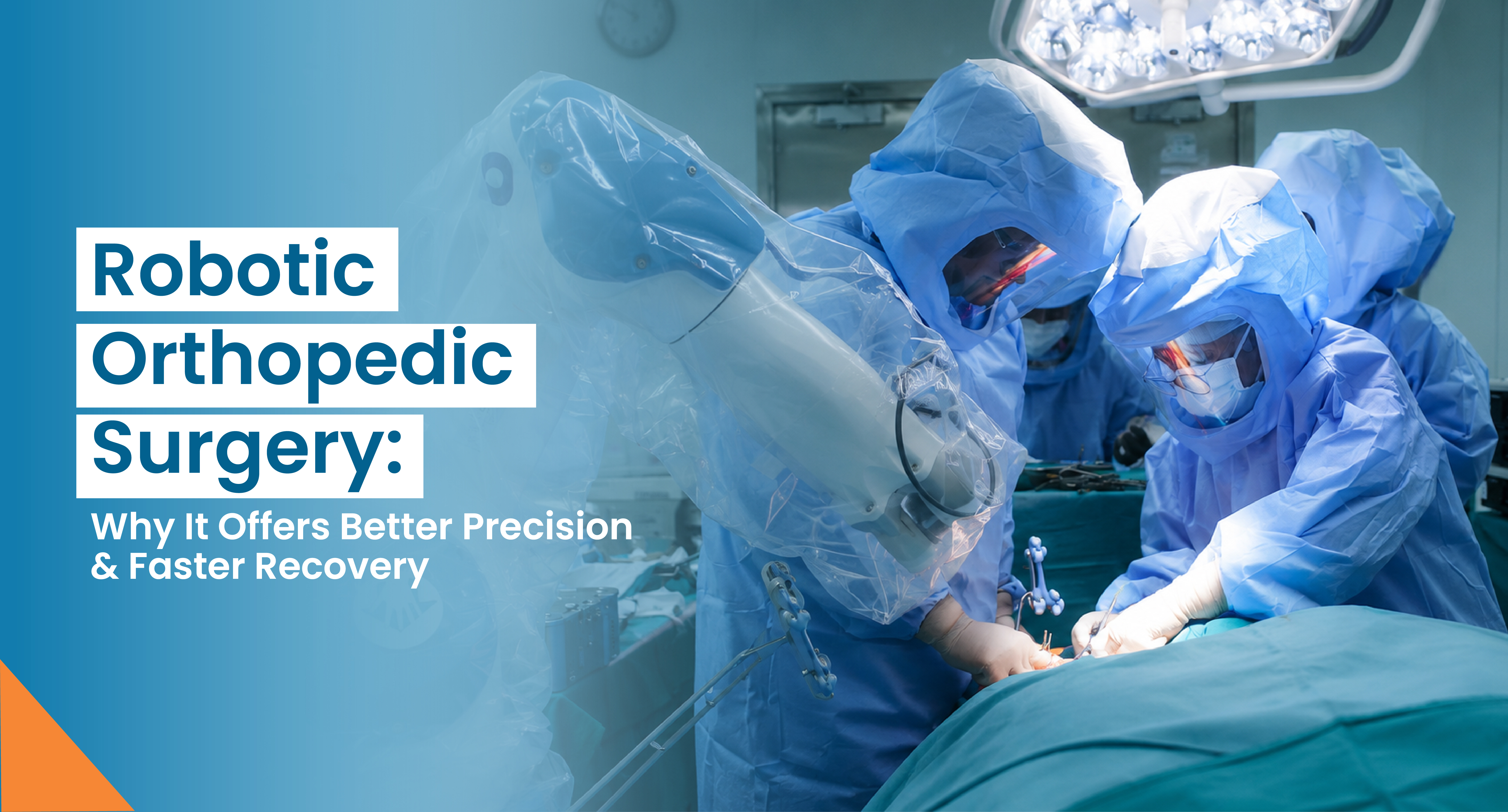
Robotic Orthopedic Surgery: Why It Offers Better Precision & Faster Recovery
07/17/2026
Just take an example of a real-life scenario: Try to place a photo frame perfectly straight on a wall. There are two ways of doing it: First, you could measure the position with your eyes; second, you could use a laser level that guides you with precise accuracy.
Both methods work, but what do you think? Which one is more likely to reduce the chances of mistakes? The answer is the second option: using a laser level. Agree!
That is exactly how robotic orthopedic surgery works.
The robotic orthopedic surgery is not the replacement of the surgeon; they act like an advanced navigation system. This helps the surgeon to perform the surgery with greater precision than the human eye alone.
This improved accuracy achieved through a robotic-arm assisted orthopedic surgery often results in:
- Better implant placement
- Less damage to healthy tissue
- Less pain
- A quicker recovery
Read this guide to learn in more detail.
Read Also: Who Needs Robot-Assisted Knee Replacement Surgery? Signs, Benefits & Recovery
Quick Answer: Is Robotic Orthopedic Surgery Better?
Yes.
However, both robotic and conventional surgery techniques have their own advantages; the one best for you will be decided by your doctor.
The potential benefits of robot assistance over traditional methods are discussed below:
| Feature | Traditional Surgery | Robotic Orthopedic Surgery |
| Implant positioning | Manual measurement | Computer-guided precision |
| Surgical planning | During surgery | Personalized 3D planning before surgery |
| Bone removal | Surgeon estimation | Highly controlled bone preparation |
| Recovery | Standard recovery | Often faster with reduced tissue damage |
| Hospital stay | Usually longer | Often shorter for suitable patients |
Read Also: VELYS AI-Powered Hip Navigation & Robotic-Assisted Knee Replacement at Eternal Hospital
What Is Robotic Orthopedic Surgery?
Robotic orthopedic surgery is a technology-assisted surgical technique (or robotic-arm assisted orthopedic surgery) used mainly for:
- Total knee replacement
- Partial knee replacement
- Total hip replacement
- Selected spine procedures
You might think that the robot performs the surgery independently; however, it's not true. The robotic technology remains in full control of your orthopaedic surgeon.
Read Also: Robotic Surgery - How can it make a difference?
How Does Robotic-Arm Assisted Orthopedic Surgery Work?
Robotic surgical systems for orthopaedics show better precision and faster recovery through these four simple steps:
1. Pre-Surgical Imaging
A computerized tomography (CT) scan before the surgery is used. This helps plan exactly how much bone needs to be removed and aids in maximising the accuracy of the alignment and placement of the implant.
2. Surgical Planning
Implant size and positioning are planned before surgery.
3. Robotic Guidance
During the surgery, the robotic arm ensures that the decided plan is followed exactly so that just enough but not too much bone is removed.
4. Implant Placement
An artificial joint is placed with high precision.
Why Better Precision is Important for Orthopedic Surgery
Because even a small alignment error may affect:
- Joint movement
- Stability
- Wear of the implant
- Overall comfort
- Implant lifespan
That's why experts in the best orthopaedic hospitals in Jaipur like Eternal Hospital use robot-assisted surgeries (for example, VELYS™ Robotic-Assisted Solution) to reduce these alignment variations by using real-time computer guidance throughout the procedure.
Read Also: Robotic Heart Surgery in India: Benefits of da Vinci Xi for Complex Cardiac Conditions
What are the Benefits of Robotic Orthopedic Surgery
Here are some of the potential advantages:
- Help achieve the desired orientation through tactile, visual and auditory feedback.
- Enhance stability and mobility.
- Maximise the accuracy of the alignment and placement of the implant.
- Often help preserve the surrounding tissues.
- Help a faster return to daily activities.
- The robotic systems create a customised surgical plan based on your individual anatomy.
Who Is a Good Candidate?
Not everyone is suitable for robotic-arm-assisted orthopaedic surgery; you must meet certain defined criteria to ensure safety.
Your orthopedic surgeon will evaluate the following:
- Age
- Bone quality
- Joint condition
- Overall medical health
- Previous surgeries
before recommending the most appropriate approach.
After a detailed evaluation it may be recommended for people with:
- Severe knee osteoarthritis
- Hip arthritis
- Chronic joint pain affecting daily life
- Failed non-surgical treatments
- Partial knee damage suitable for partial replacement
Read Also: How Is Robotic Partial Nephrectomy Changing Kidney Tumor Treatment?
Are There Any Risks?
Yes, like any other medical procedure, robotic orthopedic surgery is not free from any complications or risks.
General surgical risks remain the same as traditional joint replacement, such as:
- Infection
- Blood clots
- Nerve injury
- Implant loosening
- Joint dislocation
Read Also: When Is Robotic Hysterectomy Recommended? Conditions & Eligibility Surgery
What Is the Recovery Time for Robotic Knee Replacement
The recovery may vary person to person, based on the severity of the condition and other individual factors:
Here is the Typical Recovery Timeline
| Recovery Stage | Expected Timeline |
| Walking with support | Same day or next day |
| Returning home | Same day to 3 days |
| Daily activities | 6–12 weeks |
| Full rehabilitation | Several months |
Read Also: Everything You Need to Know About Robot-Assisted Surgery for Gall Stone Disease
Is Robotic Orthopedic Surgery Minimally Invasive Technique?
Many robotic procedures are carried out using minimally invasive orthopedic surgery techniques (accessing the organs through small cuts). But the exact approach depends on your condition and the type of joint replacement.
"Robotic" and “minimally invasive” are not identical terms.
Read Also: Robotic Hernia Repair: Faster Recovery, Less Pain & Better Outcomes
Conclusion
While no technology, including robotic assistance, can promise perfect outcomes, it can offer several potential benefits, such as improved implant positioning, preservation of healthy tissue and shorter hospital stays.
It is important to discuss all the available options for your orthopedic condition with your doctor and then make an informed choice. This helps ensure a safe and effective clinical outcome.
Looking for the best robotic orthopedic surgery hospital?
Contact Eternal Hospital, as we integrate advanced technology like the VELYS™ robotic-assisted solution with expert orthopedic care to deliver the best possible outcomes for the patients.
Our Orthopedic Experts:
Get expert advice by calling us at+91-9549158888
Our Address: Eternal Hospital, 3 A Jagatpura Road, Near Jawahar Circle, Jaipur 302017