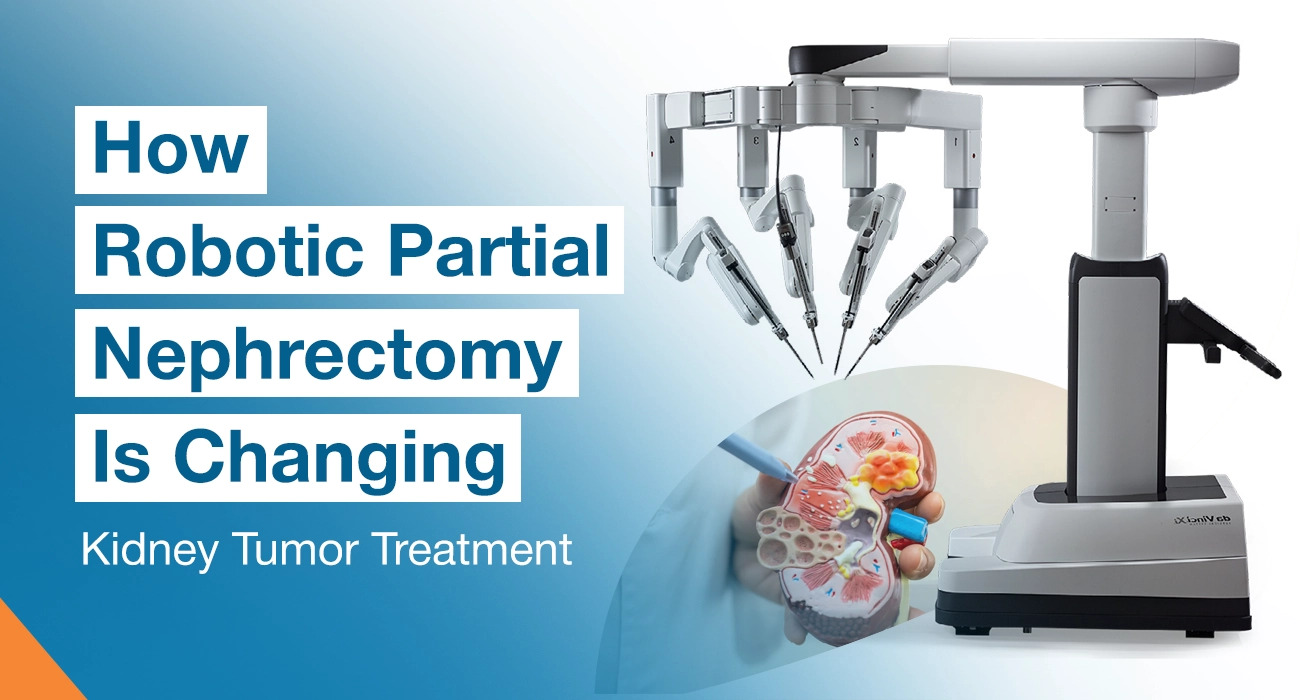
How Is Robotic Partial Nephrectomy Changing Kidney Tumor Treatment?
12/23/2025
Kidney Cancer stands as the 16th most common Cancer globally. When someone first hears the words “You have a Kidney Tumor,” the world seems to pause for a moment. The mind runs to the worst possibilities—Cancer, long hospital stays, painful surgeries, and the fear of losing a Kidney. It’s a frightening place to be, and many patients don’t even know there are options today that can treat the Tumor without removing the whole Kidney.
That’s where Robotic partial nephrectomy has quietly transformed Kidney Cancer Care. It’s not just a new surgical trend—it’s a shift in how doctors think about preserving health, organ function, and quality of life. Only highly qualified surgeons with exceptional expertise in handling advanced robotic surgical systems can successfully perform robotic kidney tumor surgery while preserving the kidney function.
Our Kidney Surgeons at Eternal Hospital are among the most skilled in performing robotic partial nephrectomy in Jaipur, a complex surgical procedure that removes the tumor while preserving the healthy Kidney tissues. These cutting-edge Robotic partial nephrectomy surgical techniques retain Kidney function while reducing hospital stays.
This blog takes you through what robotic partial nephrectomy really means, why it has become the preferred treatment for many kidney tumors, and what recovery looks like in real life.
Read Also: Robotic Surgery in Prostate Cancer: Benefits, Precision & Recovery Time
What is Robotic Partial Nephrectomy ?
For localized Kidney Cancer (Cancer that has not spread), Surgery is typically the first line of treatment. Larger open incisions or less invasive methods like Laparoscopic or Robotic Surgery can be used to remove Kidney Tumors. These Minimally Invasive techniques facilitate a quicker recovery following surgery and provide Cancer management on par with Open Surgery. Nearly all Kidney Cancer Surgeries at Eternal Hospital can be carried out with Laparoscopic or Robotic techniques that require high expertise and extensive training.
A partial Nephrectomy involves removing only the tumor-affected portion of the Kidney while leaving the remaining portion undamaged. It is usually done if the patient only has one Kidney or if the Renal Tumor is less than 7 cm. Previously, this technique used to be carried out as an open surgery, necessitating the removal of one of the patient's ribs through an 8–12 inch incision in the flank.
A less invasive option for this treatment is Robotic partial nephrectomy, which eliminates the need for the surgeon to put his or her hand inside the abdomen. This can be done using thin, specialized instruments introduced through tiny incisions. This leads to a Cancer cure rate that is comparable to open surgery, but with far less agony and a much faster recovery.
At Eternal Hospitals, this Minimally Invasive procedure is carried out with a multidisciplinary approach to treat Kidney Cancer.
Read Also: Robot-Assisted Surgeries in Urology: Revolutionization of Pyeloplasty & Nephrectomy
How Is Robotic Partial Nephrectomy Done ?
During a robotic partial nephrectomy, doctors insert a camera and special tools into the abdomen through three to four small cuts, each about one centimeter long. To remove the tumor without causing too much bleeding, the kidney's blood supply is cut off for a specific period of surgery time. After the tumor has been carefully removed from the kidney, robotic suturing procedures are used to repair the kidney defect. The tumor is removed using a retrieval bag through one of the incisions.
Read Also: What is Acute Kidney Failure and what are its symptoms?
Key Features of the da Vinci Xi Partial Nephrectomy at Eternal Hospital
Following are the key features of the advanced multiport robotic surgical system, da Vinci Xi at Eternal Hospital:
- Multi-specialty use
- Highly precise operative outcomes
- Flexible system architecture
- Fourth-generation modular design
- Highly magnified 3DHD imaging
- Integrated Firefly® fluorescence imaging for real-time visualization of tissues
- Wristed instruments
- Tremor filtration and intuitive motion technology
- Boom-mounted architecture
- Integrated table motion
- Guided setup & user-friendly interface
- Visual and audible cues
- Easy-to-learn interface
Read Also: When to See a Urologist: Common Problems and Solutions
Robotic vs Open Prostatectomy
| Aspect | Robotic Prostatectomy | Open Prostatectomy |
| Incisions | Small, keyhole cuts | Long abdominal incision |
| Pain | Usually mild | Moderate to high |
| Blood loss | Minima | Higher |
| Hospital stay | 1-2 days | 3-5 days |
| Recovery time | Faster return to work | Slower |
| Nerve-sparing chances | Better due to clear visibility | Depends on the surgeon's skill & visibility |
| Urinary control recovery | Either completely continent or recovers very fast | May take longer |
Read Also: Robotic Hernia Repair: Faster Recovery, Less Pain & Better Outcomes
Robotic vs Laparoscopic vs Open Surgery
| Specifications | Robot Assisted Surgery | Laparoscopic Surgery | Open Surgery |
| Magnification | 10X | 3X | 1X |
| Vision | 3D (Immersive) | 2D & (Non Immersive) 3D vision | 3D |
| Wrist Movement | 540 degree robotic wrist movement | 0 degree | 180 human wrist movement |
| Firefly Mode | Yes | No | No |
| Degree of Freedom | 7 degree of motion | 4 degree of motion | ___ |
| Tilepro mode | Yes | No | No |
| Port Size | 8mm | 10 to 12 mm | Big incision |
| Port site pain | Nil due to remote centre technology | Significant Pain | Very Painful |
| Blood Loss | Non significant | Minimal | Plenty |
| Infection (Port Site) | Nil due to remote centre technology | Minimal | High chances |
Partial Nephrectomy vs Radical Nephrectomy
| Partial Nephrectomy | Radical Nephrectomy |
| Removes only the tumor, while keeping the rest of the kidney intact | The entire kidney is removed along with the tumor and sometimes surrounding fatty tissue or lymph nodes |
| Often recommended when the tumor is small, early-stage, or placed in a spot where it can be safely separated from healthy kidney tissue | Commonly chosen when the tumor is larger, deeply embedded, or has spread beyond the kidney where organ-saving isn’t possible |
| Helps patients maintain better kidney function over the long term because most of the organ remains untouched. | Since the whole kidney is removed, the remaining kidney must take on all the work. For many people this is fine, but it may stress kidney function over the years. |
| Recovery tends to be quicker and less painful, especially with robotic-assisted surgery that uses tiny cuts. | Recovery can be a bit slower, mainly because the surgery is bigger and the body needs more time to adjust to having one kidney. |
| Usually preferred in younger patients, people with only one functional kidney, or those already at risk of kidney problems. | Often preferred when complete removal gives a safer, clearer margin, reducing the chance of leaving behind cancerous tissue. |
| Gives excellent cancer control for small tumors, without compromising the kidney’s future performance. | Provides strong cancer control for large or complex tumors since everything suspicious is removed. |
| Technically more challenging for the surgeon because it requires delicate reconstruction of the kidney afterward. | Technically simpler compared to partial removal, as the surgeon removes the whole organ without the need for reconstruction. |
| Offers the best chance to avoid dialysis later in life, especially in people with diabetes, hypertension, or early kidney disease. | Rarely leads to dialysis right away, but long-term kidney health depends on how strong the remaining kidney is. |
Advantages of da Vinci Xi Nephrectomy Over Traditional Surgery for Kidney Tumor
Following are the advantages of Robotic Nephrectomy over traditional Surgery for Kidney Tumors:
- Better visualization of surgical field allowing better precision
- Less pain
- Shorter hospital stay
- Quicker recovery
- Better cosmetic results
- Low rate of infection
- Fewer wound hernias
Read Also: Her Health Alert: Understanding Kidney Disease Symptoms in Females
Why Choose Eternal Hospital for Robotic Partial Nephrectomy for Kidney Tumor Treatment?
Eternal Hospital’s OTs are equipped with the latest and most advanced da Vinci Xi® Surgical System for safer and less invasive surgeries. This multi-arm surgical robotic system promotes surgical precision, stability, and efficiency, improving the surgeon's control over the surgery.
Conclusion
Patients who have only the tumor removed rather than the entire kidney have a considerably reduced risk of developing renal failure later on. When compared to traditional open surgery with comparable success rates, these minimally invasive methods offer better cosmetic results and less discomfort, blood loss, and hospital stay. In certain individuals with bigger tumors, partial nephrectomy may be ineffective, necessitating radical (or full) nephrectomy.
Consult the expert kidney tumor specialists at Eternal Hospital today. Book your consultation now!
FAQs
Q1: Who is the best Robotic partial Nephrectomy specialist in Jaipur?
A: Dr. Ravi Gupta, working at Eternal Hospital, is the best Robotic Nephrectomy specialist in Jaipur.
Q2: What are the benefits of partial Nephrectomy ?
A: Kidney Tumors are precisely and least invasively removed without opting for open procedures, leading to early recovery and less blood loss.
Q3: What is the Robotic partial Nephrectomy recovery time ?
A: You may get discharged after partial nephrectomy in 5 to 7 days. The complete recovery time varies depending upon the extent of surgery and post-discharge care of the patient.
Written and Verified by: