



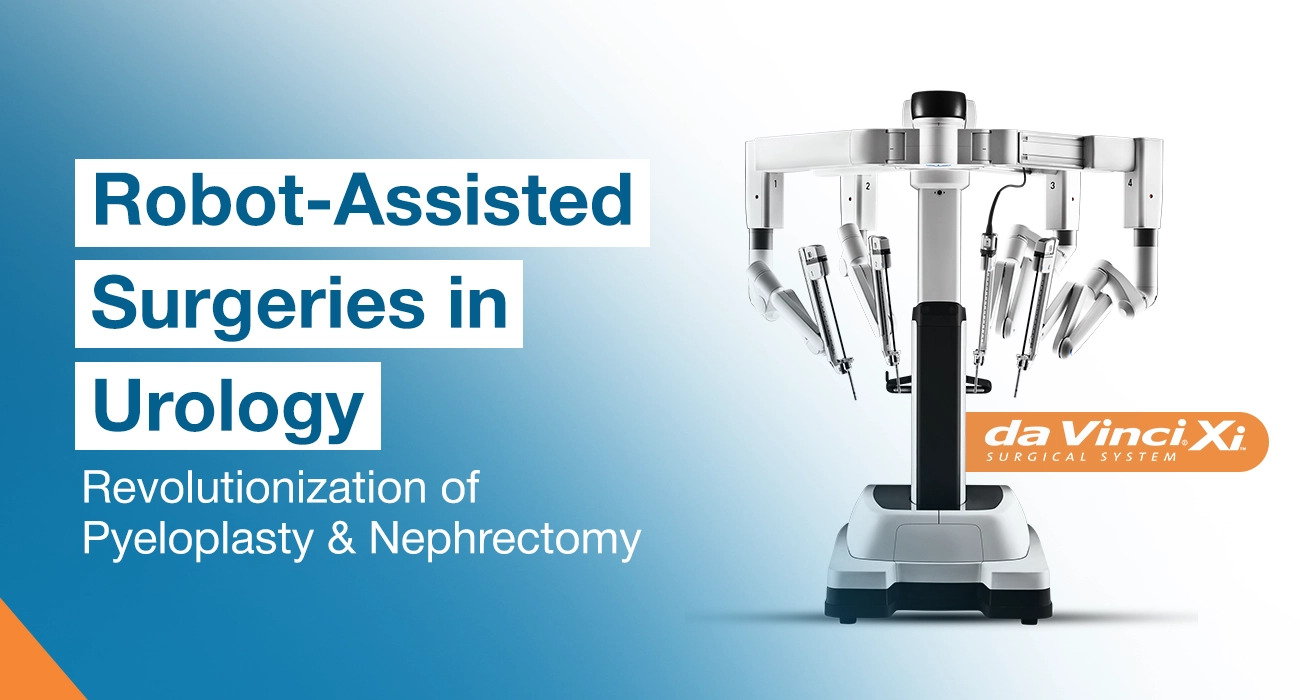
Robot-Assisted Surgeries in Urology: Revolutionization of Pyeloplasty & Nephrectomy
12/06/2025
If you speak to any urologist who has worked both in the era before robotic surgery and now, you’ll notice one thing instantly—their confidence in precision-based procedures has changed dramatically. What used to be long, demanding surgeries with wide incisions and lengthy recovery is now, in many cases, a much gentler experience for patients.
Matching steps with today’s fast-paced medical advancement, Eternal Hospital has equipped its Urology OTs with the advanced da Vinci Xi Robotic Surgical System. It has enhanced precision, reduced operating time, Port site pain and infection due to remote centre technology, increased success rate, minimized tissue invasion, reduced hospital stays, and improved recovery.
Dr. Ravi Gupta, whose experience with minimally invasive and robotic techniques has shaped how these delicate urological surgeries are performed here. Let’s scroll down to have thorough insight about how this technology has shaped modern-day urological care.
Role of Robot-Assisted Surgeries (RAS) in Urology
People often imagine a robot operating independently—but that’s not the case at all. The “robot” is essentially a highly refined tool. Think of it as giving the surgeon a pair of hands that can bend, rotate, and reach much better than human wrists ever could.
The da Vinci Xi system used at Eternal Hospital offers a magnified, three-dimensional view inside the body, something even the sharpest human eye cannot naturally achieve. The uro surgeon operates from a console, and every tiny movement of his fingers is translated into movements inside the patient—only steadier, smoother, and far more controlled.
For urological procedures, where the ureter, kidney vessels, and surrounding tissues leave very little room for error, this kind of precision becomes invaluable.
RAS-Pyeloplasty
Urine flows to your bladder via the ureter tubes after your kidneys filter the blood to eliminate waste and excess water. Urine accumulates in the kidney when the ureteropelvic junction, or UPJ, which connects the kidney to the ureter tube, gets blocked. This can result in back pain, kidney stones, vomiting, infection with fever, and bloody urine.
Doctors may need to clear the UPJ obstruction and widen the kidney-ureter connection in order to restore urine flow. Pyeloplasty is performed to treat UPJ blockage. The ureter is detached, and any obstruction, such as kidney stones, scar tissue, or an excessively small junction, is removed during pyeloplasty surgery. In order to allow urine to flow into the bladder, the surgeon subsequently reattaches the ureter to the kidney.
Da Vinci technology allows surgeons to do pyeloplasty surgery with the smallest incisions and fully wristed instruments while sitting at a console next to you or your child. High-definition, three-dimensional, magnified, real-time visuals of the interior of the body are provided by a high-resolution surgical camera, tissue handling meticulous and perfect suturing is unimaginable and much better than conventional methods.
Who is the Right Candidate for Robot-Assisted Pyeloplasty?
In the following situations, RAS-pyeloplasty is considered for management:
- Acquired UPJ obstruction in kids as well as adults
- Congenital UPJ obstruction (if condition does not improve within months)
RAS-Nephrectomy
A partial or radical nephrectomy, which involves removing a part (partial) or all (radical) of the damaged kidney, may be recommended by your doctor because of specific kidney issues. Surgeons may even remove the adrenal gland, surrounding fat, and adjacent lymph nodes during radical nephrectomies, which may be advised for kidney cancer. A partial nephrectomy, commonly known as "kidney-sparing" surgery, involves removing the tumor or damaged kidney tissue while preserving as much healthy kidney tissue as feasible.
Robot-assisted kidney surgery can be done using da Vinci technology with minimal invasion. This advanced system facilitates the operation inside the body through just fingertip-sized incisions. With the da Vinci system, your surgeon sits at a console in the operating room next to the patient.
The console enables the surgeon to control a camera for 3D high-definition (10X magnified) views and use tiny instruments to perform the surgery for the removal of the kidney tissue completely or partially. It comprehends the surgeon's even smallest movements in real time, bending and spinning devices that operate similarly to a human hand but with a wider range of motion. The built-in tremor filtration technology allows your surgeon to handle each tool with seamless accuracy.
Who is the Right Candidate for Robot-Assisted Nephrectomy?
In the following situations, RAS nephrectomy is considered for management:
- Non functioning kidney (simple, Pyelonephritic)
- Donating a healthy kidney
- Kidney tumours
- Radical Nephrectomy
- Partial Nephrectomy
- Radical Nephro urethrectomy
Read Also: All you need to know about Polycystic Kidney disease
Advantages of da Vinci Xi Assisted Urological Surgery Over Traditional Surgery
Robot-assisted urological procedures are better than surgery done via the traditional approach in the following manner:
- Far less pain than expected due to remote centre technology
- Quick return to normal activity
- Minimal scarring
- Low chances of the obstruction recurrence
- A hospital stay that often ends sooner than traditional surgery
- Laparoscopic surgery allows 4 degrees of freedom, but RAS allows 7 degrees of freedom which is even better than human wrist movements
- Conversion to open Surgery is minimised then Laparoscopic surgery
Robotic assistance during nephrectomy helps surgeons:
- “Peel off” the tumour precisely due to 10X vision and 3D HD vision whereas Laparoscopic surgery 2D HD vision and 3X magnification
- Prevention of damage to vital healthy tissue
- Repair the kidney neatly after tumour removal due to 7 degrees of Freedom
- Better long-term kidney function.
Key Features of the da Vinci Xi at Eternal Hospital
Following are the key features of this high-end technology:
- Multi-specialty use
- Highly precise operative outcomes
- Flexible system architecture
- Fourth-generation modular design
- Highly magnified 3DHD imaging with 10X magnification
- Integrated Firefly® fluorescence imaging for real-time visualization of tissues (helpful for delineating important body structures like blood vessels Ureters etc
- Wristed instruments
- Tremor filtration and intuitive motion technology
- Boom-mounted architecture
- Integrated table motion
- Guided setup & user-friendly interface
- Visual and audible cues
- Easy-to-learn interface
Why Choose Dr. Ravi Gupta for RAS-Pyeloplasty or RAS-Nephrectomy?
Dr. Ravi Gupta has spent years developing expertise in both traditional and robotic urological surgeries. This dual experience allows him to choose what’s genuinely best for each patient—not just what is technologically impressive. Dr. Gupta has successfully performed more than twenty thousand surgeries, including RAS-pyeloplasty and RAS-nephrectomy.
Conclusion
Robot-assisted surgery has genuinely transformed the field of uro care. With the capabilities of the da Vinci Xi system and the expertise of Dr. Ravi Gupta at Eternal Hospital, the pyeloplasty and nephropathy procedures are becoming less terrifying to the patients due to advantages like least tissue invasion and faster recovery.
Get RAS-pyeloplasty & RAS-nephrectomy under the expert care of Dr. Ravi Gupta.
FAQs
Q1. What is the recovery time for a Robotic Nephrectomy ?
A: Most patients can return to full activity within 3 – 4 days compared with 8-12 weeks for open partial nephrectomy.
Q2. Is Robotic Kidney Surgery painful ?
A: Robotic Kidney Surgery is performed through very small incisions with remote centre technology instead of conventional (Open / Laparoscopy) one, so most patients experience less pain, faster healing, and lower risks of complications than with traditional Open Surgery.