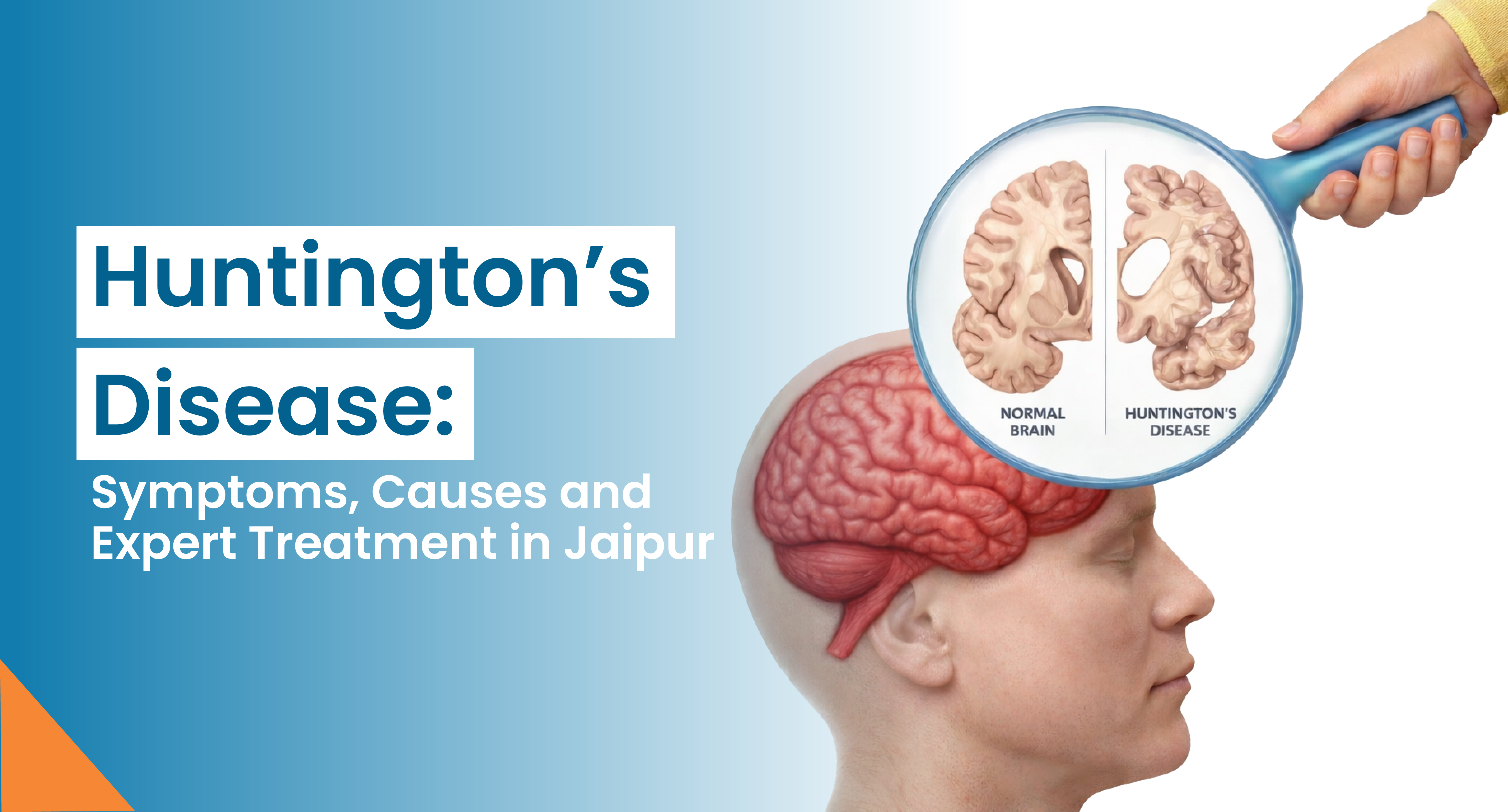
Huntington’s Disease: Symptoms, Causes, and Expert Treatment in Jaipur
01/08/2026
Huntington's disease is a neurological condition that gradually impairs a person's ability to function normally. This ultimately leads to the complete dependence of the patients on others. It often affects body movements, intellect, and mental abilities. It's a devastating illness because once the noticeable symptoms appear, patients often survive for 10 to 25 years. The disease begins with a faulty gene and ends with the progressive destruction of nerve cells.
Currently, there is no universally effective treatment for this disorder. The main focus of treatment is on alleviating the specific symptoms the patient experiences, such as mobility problems, impaired mental and functional abilities, behavioral issues, and more.
Therefore, symptom management and delaying disease progression remain the mainstays of treatment. The effectiveness of treatment greatly depends on the doctor’s expertise and the patient’s cooperation with the treatment plan, along with consistency in continuing prescribed care at home. Let’s explore more about Huntington's disease's symptoms, progression, and treatment options.
Read Also: The Impact of Alzheimer's Disease on Memory and Cognitive Function
What is Huntington’s Disease?
Huntington's disease is a hereditary disorder that negatively impacts the patient's mobility, thinking abilities, and emotional control. In this condition, the nerve cells degenerate progressively.
Because of a mutation in one of your genes, undesirable proteins start accumulating in your brain cells, resulting in deterioration of their health and their ability to work. Trouble in thinking, twitching, or changes in personality or character traits may also manifest in this disorder. Managing these symptoms can be challenging for you as well as your loved ones. Consult a neurologist to comprehend better what's going on and to have someone you can rely on when symptoms escalate.
Read Also: Can Diet Prevent Your Alzheimers
What are the Symptoms of Huntington’s Disease?
Since the illness is a chronic condition that worsens with time, dealing with the increasing severity of symptoms is the most significant challenge. The combination of worsening symptoms places a significant burden on families and caregivers.
Symptoms often develop gradually and worsen with time. Chorea, which is an abrupt jerking or twisting action, is one of the initial symptoms. It may manifest initially on the face, hands, or fingers. Afterwards, it affects your arms, legs, and the rest of your body, ultimately leading to the inability to walk, eat, or communicate. Other signs of Huntington’s disease are
- Problems in swallowing
- Slurred speech
- Muscle stiffness
- Slowing of movements
- Trouble focusing your eyes
- Trouble with balancing or coordinating the body
- Unexplained weight loss
- Poor judgment
- Anxiety
- Difficulty in planning or making decisions
- Sadness
- Hopelessness
- Poor motivation to perform
- Mood swings, anger, or irritability
- Trouble concentrating
- Memory loss
Read Also: Top most Neurological Disorders and their symptoms
What are the Causes of Huntington’s Disease?
In Huntington's disease, a mutation in a specific gene (HTT gene) is the underlying cause. Huntingtin is the protein that this abnormal gene typically produces. It promotes the health and communication of your brain cells. Movement, learning, and emotional stability are all aided by the huntingtin protein.
Alteration of a specific gene (HTT gene) produces a mutant version of the huntingtin protein. This protein is defective because it fails to arrange itself correctly. It begins to clump together within your brain cells due to the unfolding process not going according to plan. Gradually, these clusters start damaging or injuring brain cells, particularly those involved in motor control and coordination.
This abnormal protein also halts the flow of information between brain cells, ultimately negatively influencing behavior, emotional control, and thinking abilities. The severity of symptoms increases in proportion to the number of brain cells affected.
Huntington's disease is inherited due to this gene mutation. A person without a history of the disease in their family may be the first to experience the gene alteration. However, this happens in very rare cases.
Read Also: Dementia Treatment In Jaipur, India
How Is the Diagnosis of Huntington’s Disease Made?
Doctors diagnose Huntington's disease by reviewing your medical history, symptoms, family history, and test findings. If one of your biological parents or close relatives has the condition, this information can aid in diagnosing your disease. You may also be advised to get an MRI. The scan provides comprehensive images of your brain. It can detect early alterations in regions that regulate movement and coordination.
What are the Treatment Options for Huntington’s Disease in Jaipur?
There is no known cure for the disease itself. But symptoms can be managed, and the disease’s progression can be slowed down. Recently, researchers have been experimenting with new genetically based therapy approaches in the hopes of reducing the damaging substance buildup, which is the major cause behind this problem.
The following are the available treatment options for Huntington’s disease in Jaipur:
| Care Type | Purpose |
| Medications for movement control | Help reduce involuntary movements, muscle stiffness, and slowed motion |
| Medications for mood and behavior | Help manage depression, anxiety, mood swings, aggression, and irritability |
| Muscle-relaxing treatments | Help ease muscle spasms and excessive muscle tightness |
| Supportive monitoring | Regular follow-up to watch for side effects and adjust treatment as needed |
| Adaptive support tools | Assist with daily activities using devices like walkers, handrails, or special utensils |
| Emotional and psychological support | Help patients and families cope with emotional and behavioral changes |
| Nutritional support | Prevent weight loss and make eating safer and easier |
| Physical, occupational, and speech therapy | Improve movement, balance, swallowing, and communication |
Conclusion
Knowing that unwanted changes are happening to your brain and body, but not all at once, is a strange and unsettling experience. Even if you're prepared, you can be apprehensive about the future. It may be emotionally and physically taxing to live with a diagnosis of Huntington's disease, as there is no known cure.
However, many novel approaches for treating Huntington's disease are now in their experimental stage. Researchers believe these therapy approaches have a strong potential to halt or even reverse the process.
Get personalized care at Eternal Hospital from the top neurologists in Jaipur. Book your consultation now.
FAQs
Q1: What is Huntington's disease's life expectancy?
A: The average lifespan of a person with Huntington's disease is fifteen to twenty years following the onset of symptoms. There is no immediate danger of death from the disease. However, it results in impairments that gradually make routine tasks more challenging. The progression of the disease varies from person to person.
Q2: When should I consult a neurologist for my bothersome symptoms of Huntington’s disease?
A: Consult your doctor right away if any new symptoms appear or previous ones become worse. Be sure to inform them if your symptoms hinder your ability to safely carry out your everyday activities. Your doctor may modify your treatment plan if your disease progresses while you are already receiving treatment.
Q3: How does Huntington’s disease progress?
A: Huntington’s disease slowly worsens over time, though symptoms and progression vary. Early stages involve mild mood, movement, and thinking changes, while later stages cause significant difficulty with movement, speech, swallowing, and daily activities. In advanced stages, full-time care is usually required.
Written and Verified by: