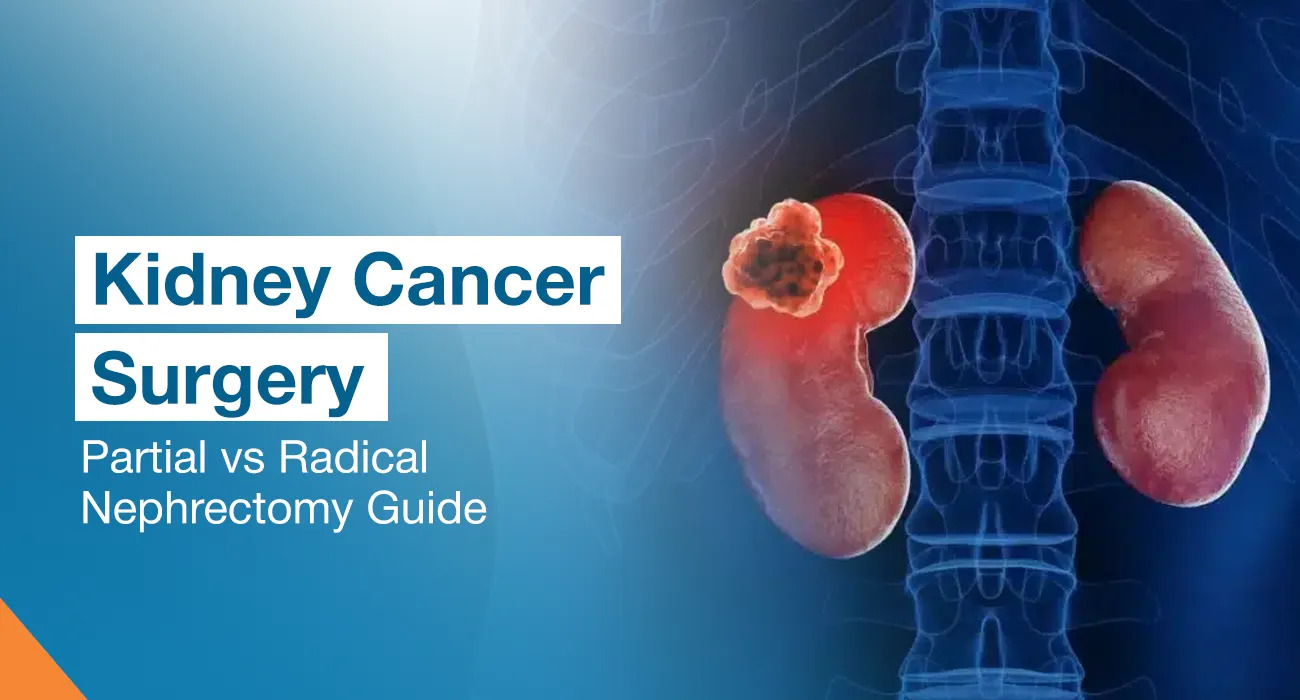
Kidney Cancer Surgery: Partial vs Radical Nephrectomy Explained
03/27/2026
Kidney cancer treatment often involves surgery; however, one of the most critical decisions patients and doctors face is “choosing between partial nephrectomy and radical nephrectomy.”
Both procedures have their own benefits, and your doctor will let you know which is best for you.
Experts recommend partial nephrectomy for tumors without high oncologic potential (size < 4 cm, low-grade biopsy, non-infiltrative imaging).
Radical nephrectomy may be preferred when the tumor shows aggressive features (larger size, high‑grade histology such as Fuhrman grade 4), infiltrative imaging (involving fat or surrounding structures), or complex anatomy that makes partial nephrectomy technically difficult or risky. It is also more commonly chosen when the contralateral kidney (the kidney on the opposite side of the body from a diseased one) is normal and has adequate function (e.g., predicted eGFR ≥45–60 mL/min).
Understand the differences, benefits, risks, and when each procedure is recommended to make an informed choice.
Read Also: Her Health Alert: Understanding Kidney Disease Symptoms in Females
What is Partial Nephrectomy?
It is a kidney-sparing surgery and can be performed via open, laparoscopic, or robotic surgery.
It removes only the tumor and a small rim of healthy kidney tissue while preserving the rest of the organ. Surgeons open the kidney's surrounding fascia, excise the mass, and reconstruct the kidney with sutures to promote healing.
Think of this like removing a bad spot from an apple while keeping the rest intact.
This approach saves about 80% of the kidney on average. This makes it ideal for smaller tumors up to 4 cm, which often have low oncologic risk.
Read Also: How Heart Disease Can Lead to Kidney Failure: The Hidden Risk
What is Radical Nephrectomy?
It is a complete kidney removal surgery. A surgeon removes the entire kidney, along with the fat that surrounds it, and in some cases, the adrenal gland and the lymph nodes around your kidney.
It can be done via open surgery (large incision) or minimally invasive methods, including laparoscopic or robotic techniques.
Key Differences: Partial vs Radical Nephrectomy
Both are effective treatments, but the choice depends on tumor size, location, patient health, and cancer aggressiveness.
| Points | Partial Nephrectomy | Radical Nephrectomy |
| Also Known as | Kidney-sparing surgery or nephron-sparing surgery (NSS | Complete nephrectomy or total nephrectomy. |
| Key Features | Removes the cancer while preserving most of the kidney. Typically saves about 80% of kidney function. Requires reconstruction of the remaining kidney tissue. Can be performed via open, laparoscopic, or robotic surgery. |
Complete removal of the affected kidney Often performed using minimally invasive techniques. No reconstruction required |
| Advantages | Better long-term kidney function Lower risk of chronic kidney disease (CKD) Ideal for younger patients or those with pre-existing kidney issues |
Simpler and faster procedure. Lower immediate surgical risk. May provide better cancer control in aggressive tumors. |
| Disadvantages | Technically more complex surgery Slightly higher risk of complications due to reconstruction Not always suitable for large or centrally located tumors |
Loss of one entire kidney Potential risk of reduced kidney function long-term Not ideal for patients with existing kidney disease |
| Often Recommended | For small tumors (typically under 4–7 cm). When preserving kidney function is critical. |
For larger, more complex, or aggressive tumors. |
Risks or Complications of a Partial Nephrectomy
When performed under professional guidance, the surgery is safe; however, it may carry the following risks:
- Anesthesia risks.
- Healing issues.
- Blood clots.
- Possible need for a blood transfusion.
- Infection.
- Mass of clotted blood.
- Fluid buildup at surgical sites.
Risks or Complications of a Radical Nephrectomy
When performed under professional guidance, the surgery is safe; however, it may carry the following risks:
- Infection
- Scarring
- Bleeding
- Post-operative pneumonia
- Blood clots
- Complications due to anesthesia
Recovery
- Partial nephrectomy recovery: 4–12 weeks depending on technique.
- Radical nephrectomy recovery: 8–12 weeks on average.
Most patients can live normal lives with one kidney, as long as the remaining kidney is healthy.
Advances in Kidney Cancer Surgery
Modern techniques have significantly improved outcomes:
- Robotic-assisted surgery allows precise tumor removal.
- Minimally invasive procedures reduce pain and recovery time.
- Better imaging tools help predict post-surgery kidney function.
Experts at Best Nephrology Hospital can now estimate how much kidney function will remain after surgery by analyzing kidney tissue volume, making treatment decisions more personalized.
The Longstanding Controversy: Which Is Better?
The debate between partial and radical nephrectomy has been ongoing for years. According to experts from Cleveland Clinic, both approaches have clear benefits—but no one-size-fits-all answer.
Many studies suggest that preserving kidney tissue leads to better long-term health outcomes. Patients who retain more kidney function are less likely to develop chronic kidney disease, which is linked to cardiovascular problems and reduced survival.
This is why partial nephrectomy is now considered the standard of care for small kidney tumors.
Conclusion
Choosing between partial and radical nephrectomy is not just about removing cancer, it’s about balancing oncologic safety and long-term kidney health.
The best approach depends on individual patient factors, tumor characteristics, and surgical expertise.
Partial Nephrectomy May be Preferred When:
- Tumor is small and localized
- Patient has only one kidney
- There is pre-existing kidney disease
- Tumors are present in both kidneys
- Patient is younger and needs long-term kidney function
Radical Nephrectomy May be Recommended When:
- Tumor is large or aggressive
- Cancer has higher oncologic potential
- Tumor is located in a complex or central position
- Patient has a healthy opposite kidney
- Partial surgery would carry higher risk
Schedule An Appointment today: +91-9549158888
Written and Verified by: