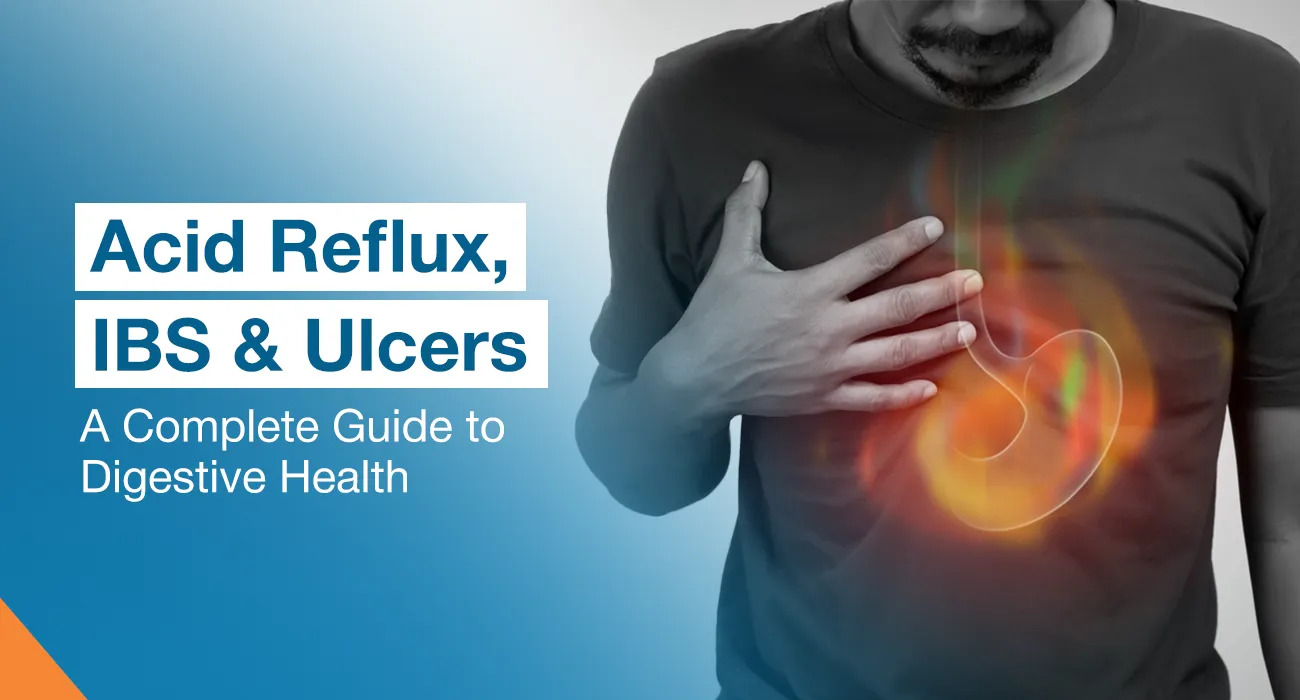
Acid Reflux, IBS & Ulcers: A Complete Guide to Digestive Health
04/14/2026
Your digestive system breaks down food and liquid into their chemical components such as carbohydrates, fats, proteins, vitamins, and minerals. Then your body absorbs all these nutrients for energy and builds or repairs cells.
However, digestive system problems like acid reflux, IBS and ulcers may interfere with proper digestion and, in some cases, nutrient absorption, leading to long‑term health issues if untreated.
Hence, if you are experiencing symptoms like burning chest pain, a sour taste, regurgitation, crampy pain, bloating, bowel changes, gnawing upper pain, or worse, an empty stomach, consult your gastroenterologists. Timely checkups help detect the underlying cause and guide you towards effective treatment options.
What is Acid Reflux
Your stomach contents need to travel only one way, i.e., downwards. However, when acid from inside your stomach flows backward — meaning, up — into your esophagus and throat, this condition is known as acid reflux.
Occasional acid reflux can be uncomfortable, but it’s not a disease. But some individuals have reflux all the time (chronic acid reflux, also known as GERD), which can really affect the quality of life and do real damage to your tissues.
Common causes of acid reflux include:
Symptoms of Acid Reflux
The symptoms be feel like:
- Acid, food or liquids backwashing from your stomach into your throat after eating.
- A burning feeling.
- Noncardiac chest pain.
- Nausea.
- Sore throat.
Don't get confused between acid reflux and gastro-oesophageal reflux disease (GERD). Acid reflux is the event; GERD is the chronic disease form of that event.
Your gastroenterologist can recommend management options based on the severity of your condition. This includes lifestyle adjustments, like changing their eating habits, reducing alcohol and tobacco and losing weight and prescription medications for GERD, such as histamine receptor antagonists (H2 blockers), proton pump inhibitors (PPIs), etc.
What is Irritable Bowel Syndrome (IBS)
IBS is a group of symptoms that affects the stomach and intestines, also called the 'gastrointestinal tract'. It’s a common but uncomfortable gastrointestinal disease that affects your intestines.
The types of IBS are based on the kind of abnormal days you experience:
- IBS with constipation (IBS-C): Most of the poop is hard and lumpy.
- IBS with diarrhoea (IBS-D): Most of the poop is loose and watery.
- IBS with mixed bowel habits (IBS-M): Both hard and lumpy bowel movements and loose and watery movements.
Experts don’t know exactly what causes IBS, but it is generally triggered by a combination of factors, including abnormal muscle contractions in the gut, nervous system malfunctions, and high sensitivity to certain stimuli.
Symptoms of IBS
- Abdominal pain or cramps, generally related to the urge to poop.
- Excessive gas and bloating.
- Diarrhoea, constipation or alternating between the two.
- Mucus in the poop.
- Feeling like you’re incapable of emptying the bowels after pooping.
Your gastroenterologist can recommend management options based on the severity of your condition. They can suggest to you:
- Modify eating/drinking habits.
- Aim for 150 minutes of moderate exercise weekly.
- Try daily yoga, meditation and other de-stressing techniques.
- Therapies like cognitive behavioural therapy (CBT), hypnotherapy and biofeedback.
- Medications like dicyclomine, hyoscyamine, etc.
What are Ulcers?
A stomach ulcer (or gastric ulcer or peptic ulcers) is an open sore in the lining of the stomach. Stomach ulcers are common and treatable, but they can become serious if not treated for a long time. These ulcers feel like a sore spot in the stomach, which is located in the upper abdomen, between your breastbone and your belly button, a little to the left.
There are mainly two causes of peptic ulcers: Helicobacter pylori (H. pylori) bacterial infection and long-term use of nonsteroidal anti-inflammatory drugs (NSAIDs) like ibuprofen or aspirin.
Symptoms of Ulcers
Some individuals have no symptoms until complications develop like bleeding or a perforation (hole); these are called silent ulcers.
If symptoms appear, they can include the following:
- Burning or gnawing pain in the upper abdomen which is often worse at night or between meals.
- Pain that may improve temporarily after eating or antacids. The pain can sometimes worsen after meals.
- Indigestion or discomfort post-meal, with a feeling of fullness very quickly or for a long time after meals.
- Bloating and belching.
- Heartburn or acid reflux.
- Nausea, sometimes vomiting.
Your gastroenterologist can recommend management options based on the severity of your condition. They can prescribe combination of medications to reduce stomach acid, coat and protect the ulcer during healing, and kill any infection involved. Sometime the expert might consider procedures (pyloroplasty or vagotomy) to stop bleeding or repair a hole.
Medications to treat stomach ulcers include:
- Tetracycline
- Metronidazole
- Clarithromycin
- Amoxicillin
- Sucralfate
- Misoprostol
- Bismuth subsalicylate
Difference Between Acid Reflux, IBS & Ulcers
Here are the differences between these three digestive issues.
| Feature | Acid Reflux (GERD) | IBS | Peptic Ulcer |
| What it is | Backflow of stomach acid into the esophagus causing irritation | Functional bowel disorder affecting colon motility and sensitivity | Open sore in the lining of stomach or duodenum |
| Main organ involved | Esophagus | Large intestine (colon) | Stomach and/or duodenum |
| Typical pain location | Burning in chest (heartburn), sometimes upper mid-chest or throat | Crampy lower or central abdominal pain | Burning/gnawing pain in upper abdomen (epigastric region) |
| Pain timing | After meals, on lying down or bending forward | Related to bowel movements; better after passing stool | Often worse when stomach is empty, may improve briefly after eating |
| Risk factors | Obesity, late-night meals, spicy/fatty foods, alcohol, smoking | Stress, anxiety, certain foods, hormonal factors | NSAIDs, H. pylori, smoking, family history |
| Typical treatment focus | Acid suppression + lifestyle modification | Diet modification, stress management, gut-directed medications | Ulcer healing with PPIs + antibiotics (if H. pylori) |
| Role of diet/lifestyle | Very important: avoid trigger foods, no late meals, weight loss | Very important: low FODMAP or tailored diet, regular meals, stress control | Important: avoid NSAIDs, smoking, alcohol, very spicy and irritating foods |
Conclusion
Digestive health issues like acid reflux, IBS and ulcers can be emotionally and physically challenging. But by understanding the underlying cause, adhering to disease-specific care, and maintaining regular follow-ups with gastroenterologist, you can live a full, active life. This will significantly lower your risk of complications such as bleeding, perforation, and gastric outlet obstruction.
The Best Department of Gastroenterology at Eternal Hospital
Located at the heart of Jaipur, Eternal Hospital is a one-stop healthcare facility for all your gastrointestinal chronic issues and offers comprehensive care for general and preventive care for all ages.
Our Internal Medicine Specialist
Watch our patient testimonial here
Eternal Hospital is the preferred hospital for a reason because of our accreditation and affiliations.
- Awarded the gold seal by JCI
- Affiliated with Mount Sinai Hospital
- Facilitated with ACC for excellence in heart care
- Accredited with NABH for strict adherence to quality
- Accredited with NABL for testing and calibration laboratories
Our address: Eternal Hospital, 3 A Jagatpura Road, Near Jawahar Circle, Jaipur 302017
For appointments, call at: +91-9549158888
FAQs
Q1: Acid reflux vs. heartburn. What is the difference?
A: The simple difference is the following: Acid reflux is stomach acid flowing back into the esophagus (food pipe); heartburn is the burning chest discomfort that results, making heartburn a symptom of acid reflux.
Q2: How to improve digestive health?
A: Here are the top 5 tips that you can follow:
- Eat more fiber.
- Include probiotics and prebiotics.
- Limit processed and fatty foods.
- Stay hydrated.
- Identify food triggers such as spicy foods, dairy (if intolerant), or citrus and avoid them.
Written and Verified by: