



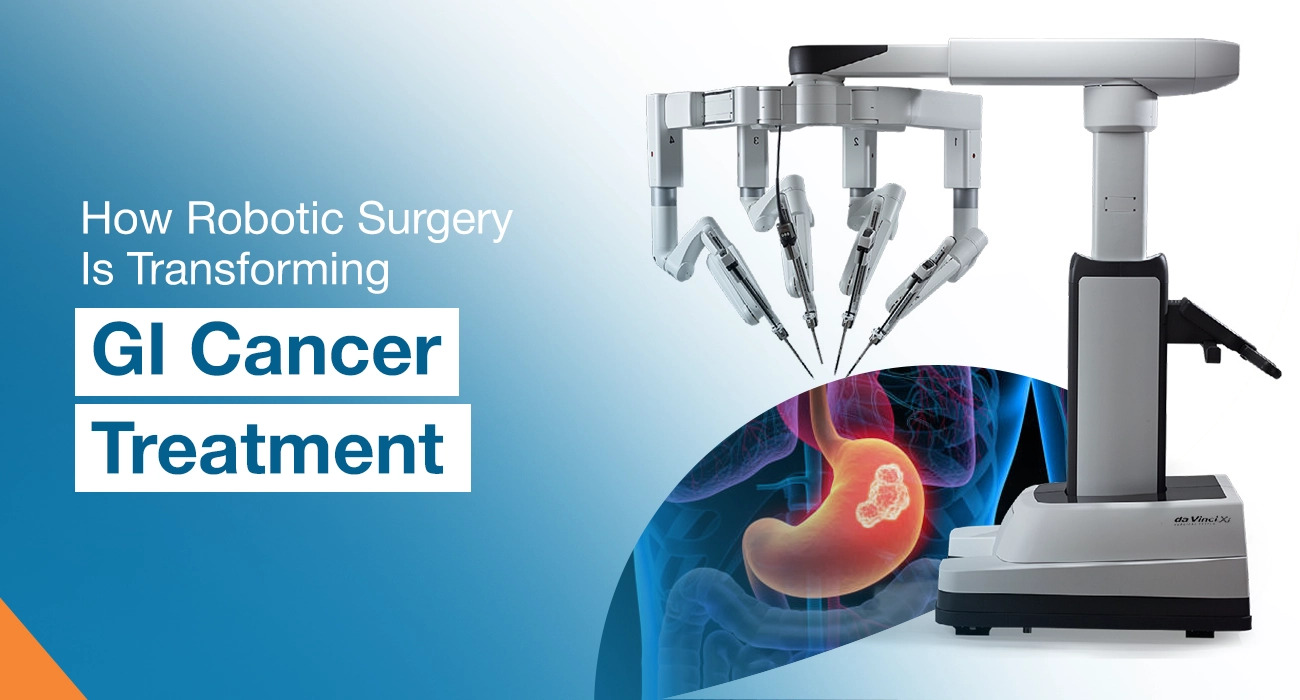
How Robotic Surgery Is Transforming GI Cancer Treatment
06/06/2026
After hearing the word “robotic surgery,” most people think that a robot is independently performing surgery, like something from a sci-fi movie. However, that’s not how modern robotic surgery for gastrointestinal (GI) cancer works.
In reality, robotic systems are advanced surgical tools completely controlled by highly trained surgeons. The robotic technology is there to improve precision, flexibility, and visualization. This enables doctors to perform complex gastrointestinal cancer treatment procedures through tiny incisions instead of large open surgeries.
And that is exactly why robotic surgery is transforming GI oncology today.
For many individuals with colorectal cancer, pancreatic cancer, stomach cancer, liver cancer, or esophageal cancer, robotic cancer surgery is:
- reducing blood loss,
- shortening hospital stays,
- improving recovery time,
and in some cases even improving surgical accuracy.
But you still might have some valid queries like:
- Is robotic surgery always better?
- Who is the right candidate?
- What are the risks?
- Why are leading cancer centers rapidly investing in robotic GI oncology programs?
Read this guide to clear all your doubts and understand how robotic surgery is contributing to GI cancer treatment.
Read Also: Robotic Surgery - How can it make a difference?
What Is Robotic Surgery for GI Cancer?
Robotic surgery for GI cancer is a minimally invasive surgical technique where a surgeon uses a robotic-assisted platform, most commonly the da Vinci Surgical System, to perform highly precise cancer operations.
Instead of making one large incision, surgeons operate through several tiny cuts using robotic arms equipped with miniature surgical instruments and a high-definition 3D camera.
Think of it like upgrading from standard-definition TV to ultra-HD gaming controls.
Traditional laparoscopy already improved surgery by reducing incision size. Robotic systems take it one step further by improving:
- Hand precision
- Instrument flexibility
- Surgical visibility
- Motion control
- Access to narrow anatomical spaces
The surgeon remains fully in control throughout the procedure.
Read Also: Robotic Heart Surgery in India: Benefits of da Vinci Xi for Complex Cardiac Conditions
What is the da Vinci Surgical System?
The da Vinci surgical system is defined as a robotic surgical assistant that consists of a surgeon’s console and a three-arm surgical manipulator. This allows surgeons to perform minimally invasive procedures with enhanced precision and stability through a high-resolution 3D view of the surgical field.
Read Also: How Is Robotic Partial Nephrectomy Changing Kidney Tumor Treatment?
Which GI Cancers Can Be Treated with Robotic Surgery?
Today, robotic cancer surgery is commonly used in several GI oncology procedures.
| GI Cancer Type | Common Robotic Procedures |
| Colorectal Cancer | Robotic colectomy, rectal surgery |
| Pancreatic Cancer | Robotic Whipple procedure, distal pancreatectomy |
| Stomach Cancer | Robotic gastrectomy |
| Liver Cancer | Robotic liver resection |
| Esophageal Cancer | Robotic esophagectomy |
Among these, robotic rectal cancer surgery currently has the strongest clinical evidence supporting better surgical precision and functional outcomes.
Read Also: When Is Robotic Hysterectomy Recommended? Conditions & Eligibility Surgery
Why Is Robotic Surgery Becoming Popular in GI Oncology?
The simplest answer is this:
GI cancer surgery is extremely delicate.
Surgeons often operate near major blood vessels, nerves, lymph nodes, and organs packed tightly inside the abdomen or pelvis. Even tiny movements matter.
Robotic systems help surgeons work with greater control in these confined spaces.
Imagine trying to repair a watch using kitchen gloves versus precision instruments. That’s similar to the difference surgeons describe between conventional surgery and robotic-assisted systems.
Here are the biggest reasons robotic surgery is expanding in gastrointestinal cancer treatment.
Read Also: Everything You Need to Know About Robot-Assisted Surgery for Gall Stone Disease
1. Smaller Incisions and Faster Recovery
One of the most obvious benefits is minimally invasive access.
Compared to open surgery, robotic procedures usually involve:
- Smaller cuts
- Less tissue trauma
- Reduced postoperative pain
- Lower infection risk
- Faster return to daily activities
For cancer patients, this matters a lot because recovery speed can affect how quickly additional treatments like chemotherapy begin.
Typical Recovery Comparison
| Surgical Type | Hospital Stay (Approximate Range) | Recovery Time |
| Open Surgery | 7–14 days | Several weeks to months |
| Laparoscopic Surgery | 4–7 days | Faster recovery |
| Robotic Surgery | 3–6 days | Often, the fastest recovery |
Note: Recovery still depends on the complexity of the cancer and the patient’s overall health.
Read Also: Robotic Hernia Repair: Faster Recovery, Less Pain & Better Outcomes
2. Better Precision in Difficult Areas
Some GI cancers are located in extremely tight anatomical spaces.
Rectal cancer surgery, for example, happens deep inside the pelvis where visibility and instrument movement are limited.
Robotic systems provide:
- 3D magnified visualization
- Wristed instruments with a greater movement range
- Tremor filtering
- Motion scaling
This allows surgeons to perform more precise dissections around nerves and blood vessels.
Studies on robotic rectal surgery have shown improved preservation of urinary and sexual function compared to some traditional approaches.
That’s a major quality-of-life benefit after cancer treatment.
Read Also: All You Need to Know About Robotic Radical Hysterectomy
3. Lower Conversion to Open Surgery
One of the hidden advantages of robotic cancer surgery is lower conversion rates.
Sometimes minimally invasive procedures become too difficult and surgeons must switch to open surgery during the operation.
Research across pancreatic, gastric, liver, and colorectal procedures consistently shows robotic surgery often reduces these conversions.
Why does this matter?
Because avoiding conversion may help reduce complications, blood loss, and longer recovery times.
Read Also: Robot-Assisted Surgeries in Urology: Revolutionization of Pyeloplasty & Nephrectomy
4. Improved Visualization for Surgeons
Modern robotic systems offer incredibly detailed imaging.
Surgeons operate using high-definition, three-dimensional views that magnify tissues, vessels, and lymph nodes.
Some robotic systems also integrate fluorescence imaging technology.
This helps surgeons:
- Identify blood flow
- Visualize lymphatic pathways
- Detect important structures
- Improve tumor localization
In GI oncology, where clean tumor margins are critical, enhanced visualization can improve surgical confidence.
Read Also: Robotic Surgery in Prostate Cancer: Benefits, Precision & Recovery Time
Is Robotic Surgery Better Than Laparoscopic Surgery?
This is where the conversation gets more nuanced.
Robotic surgery is not automatically “better” in every case.
Laparoscopic surgery already provides excellent outcomes for many gastrointestinal cancer treatment procedures.
However, robotic systems may offer advantages in technically difficult surgeries such as:
- Low rectal cancer
- Pancreatic surgery
- Obese patients
- Narrow pelvic anatomy
- Complex reconstructions
Here’s a simple comparison.
| Feature | Laparoscopic Surgery | Robotic Surgery |
| Visualization | 2D/3D | Advanced 3D HD |
| Instrument Flexibility | Limited | Highly articulated |
| Surgeon Ergonomics | Moderate strain | Improved comfort |
| Precision | High | Very high |
| Cost | Lower | Higher |
| Operating Time | Usually shorter | Often longer |
The biggest downside of robotic surgery remains cost and longer operative time.
Read Also: Robotic Myomectomy for Fibroids: Fertility, Recovery & Success Rates
What Are the Risks of Robotic GI Cancer Surgery?
Although robotic surgery is advanced, it is still major surgery.
Potential risks include:
- Bleeding
- Infection
- Anastomotic leak
- Blood clots
- Delayed bowel function
- Injury to nearby organs
There are also robotic-specific limitations.
Current Challenges Include:
- Higher procedural costs
- Longer operating times
- Learning curve for surgeons
- Limited tactile feedback
- Need for high surgical expertise
In simpler terms, the robot is only as good as the surgeon using it.
High-volume cancer centers with experienced robotic surgeons generally achieve the best outcomes.
Read Also: Robotic Ovarian Cyst Removal: Cost, Recovery & Risks
Who Is a Good Candidate for Robotic Surgery?
Not every patient is an ideal candidate.
Doctors usually consider robotic surgery when:
- Cancer is localized or early-stage
- Minimally invasive access is feasible
- The patient can tolerate surgery
- Complex precision surgery is required
Patients with extensive scar tissue, widespread disease, or severe medical conditions may still require traditional surgery.
The decision is highly personalized.
Read Also: Robotic Prostate Surgery in Jaipur: Advanced Treatment for Prostate Problems
How Robotics Is Shaping the Future of GI Oncology
The future of GI oncology is moving toward precision-driven, personalized surgery.
And robotics is becoming central to that shift.
Emerging technologies include:
- AI-assisted surgical navigation
- Augmented reality overlays
- Enhanced fluorescence imaging
- Single-port robotic surgery
- Flexible robotic endoscopy
- NOTES (Natural Orifice Transluminal Endoscopic Surgery)
Researchers are also developing robotic systems for advanced endoscopic procedures like ESD (Endoscopic Submucosal Dissection), which may allow extremely early cancers to be removed without external incisions.
In the future, robotic systems may become smaller, smarter, and more accessible.
Read Also: Uterine Prolapse Treatment Without Hysterectomy – Robotic Options
The Bigger Picture: Why Robotic Surgery Matters
Here’s the most important thing patients should understand:
Robotic surgery is not replacing surgeons.
It is enhancing what skilled surgeons can do.
The real goal is not flashy technology. The goal is:
- Safer surgery
- Better cancer removal
- Faster recovery
- Improved quality of life
- Better long-term outcomes
Right now, the strongest evidence exists in robotic rectal cancer surgery. For pancreatic, gastric, and liver cancers, research is still evolving.
But one trend is very clear:
Robotic surgery for GI cancer is no longer experimental. It is becoming a major part of modern gastrointestinal cancer treatment.
Conclusion
The rise of robotic cancer surgery represents one of the biggest shifts in modern GI oncology.
While robotic systems still come with challenges like higher costs and longer operating times, their advantages in precision, visualization, and minimally invasive treatment are changing how surgeons approach complex gastrointestinal cancers.
For patients, this often means:
- Smaller incisions
- Less pain
- Faster recovery
- Shorter hospital stays
- Better functional outcomes
As technology continues to evolve and long-term data grow, robotic surgery will likely become even more integrated into standard gastrointestinal cancer treatment strategies.
The future of GI oncology is not just about removing cancer.
It’s about treating cancer more precisely, more safely, and with a better quality of life after surgery.