



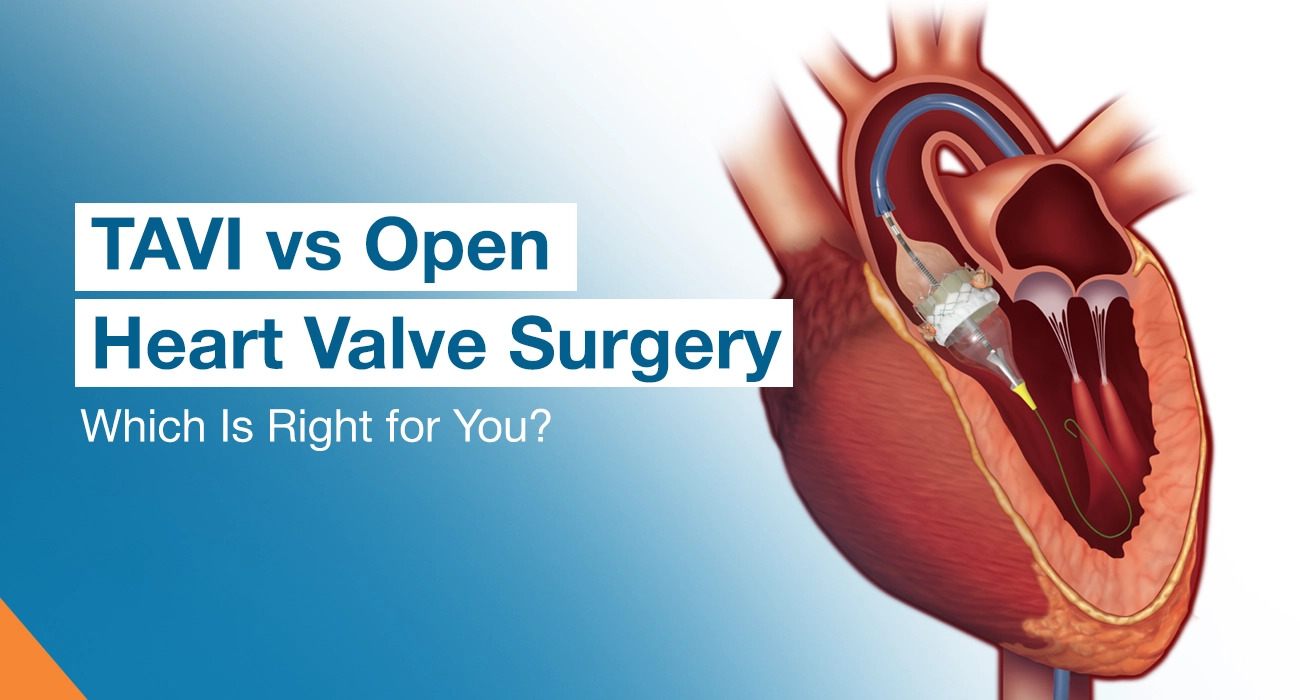
TAVI vs Open Heart Valve Surgery: Which Is Right for You?
07/18/2026
If you have been recently diagnosed with severe aortic valve disease, the effective treatment is based on your age, overall health, heart anatomy, and whether you require other heart procedures.
A TAVI procedure (Transcatheter Aortic Valve Implantation) is a minimally invasive procedure (techniques to access your organs through surgical cuts) that replaces your aortic valve without open-heart surgery. This technique provides faster recovery and is often recommended for older or high-risk individuals who cannot have open-heart surgery.
Open heart valve surgery remains the preferred choice for many younger patients, those who need a mechanical valve, or individuals in need of additional procedures like bypass surgery.
Therefore, the choice between TAVI vs Open Heart Valve Surgery should always be made by an experienced multidisciplinary heart team.
Read Also: An Overview of Transcatheter Aortic Valve Implantation TAVI: What You Need to Know
What Is Aortic Valve Disease?
Aortic valve disease is a form of heart valve disease that stops the aortic valve from working properly.
The aortic valve is like a door that manages blood flow from the heart’s main pumping chamber (left ventricle) into a large artery known as the aorta. This aortic valve is supposed to open and close entirely to help keep the heart working as it should.
If it has trouble doing either or both, you have these conditions:
Aortic Valve Stenosis
The valve opening is narrowed or blocked. Hence, not much blood can go through.
Aortic Valve Regurgitation
The valve doesn’t close tightly and is “leaky.” This means some blood flows backward in the wrong way each time the heart beats.
Modern medicine offers two highly effective ways to replace the damaged valve:
- TAVI procedure (Transcatheter Aortic Valve Implantation)
- Open heart valve replacement surgery (Surgical Aortic Valve Replacement or SAVR)
But which one is right for you? It's based on your age, overall health, heart anatomy, and the final decision of the multidisciplinary heart team.
What Is the TAVI Procedure?
The TAVI procedure is a minimally invasive procedure also known as Transcatheter Aortic Valve Implantation (TAVI) or TAVR.
TAVR replaces the damaged aortic valve and does not require opening the chest.
An interventional cardiologist inserts a thin tube (catheter) into an artery, usually in the groin, and guides it to the heart. The catheter delivers the new valve, placing it inside the old one, where it immediately begins working.
Unlike open-heart surgery, the heart usually keeps beating throughout this minimally invasive procedure.
Read Also: Life After TAVI: Recovery Timeline, Precautions & Long-Term Benefits
What are the Key Features of TAVI Surgery?
- Here are the major features:
- Small incisions
- Shorter hospital stay
- Faster recovery
- Preferred choice for older adults and higher-risk patients
Read Also: Who Is The Ideal Candidate For TAVI? Understanding Eligibility & Benefits
What Is Open Heart Valve Surgery?
Open heart valve surgery is also known as Surgical Aortic Valve Replacement (SAVR). This is a more invasive procedure where the doctor opens the chest via the breastbone to remove the damaged valve and replace it with a new biological or mechanical valve.
During the procedure, the heart is temporarily stopped, and a heart-lung machine is used to maintain blood circulation.
It remains the gold standard for many people, generally younger ones and those in need of additional cardiac procedures.
Read Also: Modern Cardiac Care: The Role of TAVR in Structural Heart Disease Treatment
What's the Difference Between the TAVI Procedure vs. Open Heart Surgery?
Explore the table below to find your answer.
| Comparison | TAVI Procedure | Open Heart Valve Surgery |
| Procedure type | Minimally invasive | Major surgery |
| Chest incision | No | Yes |
| General anesthesia | Sometimes not required | Usually required |
| Heart-lung machine | No | Yes |
| Hospital stay | 1–3 days | 5–7 days |
| Recovery | Faster | Longer |
| Pain after procedure | Less | More |
| Suitable for | Older/high-risk patients | Younger/low-risk patients or complex cases |
Why is TAVR Not Recommended?
The most common reasons your provider may not recommend TAVR include:
- Heart attack within the last month
- Congenital heart defects
- A space that’s too short for the new valve to fit
- Recent stroke or transient ischemic attack (TIA)
- Severe kidney disease
- Severe weakening of certain parts of your heart
- Other heart valve problems, like mitral regurgitation (leaky mitral valve)
Read Also: Steps to follow post TAVI procedure
FAQs
Is it better to repair a heart valve or to replace it?
If possible, doctors prefer repairing a heart valve over replacing it because it preserves your natural valve, leading to better long-term heart function.
Can I walk after a TAVI procedure?
For the first 2 weeks after your surgery, it's best to exercise little and often after your doctor's approval. You can begin by walking around the house and taking short walks outside.
How long does a TAVI valve last?
Present studies suggest that TAVI valves function well for 10–15 years or longer. But long-term durability continues to be studied.
Which Procedure Offers Faster Recovery?
Here is the quick comparison:
| Recovery Factor | TAVI Procedure | Open Surgery |
| Walking | Same day or next day | After several days |
| Hospital discharge | 1–3 days | Around 5–7 days |
| Return to routine | Within days to weeks | Usually 6–10 weeks |
| Driving | Around 2–4 weeks | Around 6 weeks |
| Heavy lifting | Avoid for about 1 week | Avoid for 6–8 weeks |
Conclusion
Choosing between the TAVI procedure and open heart valve surgery is not about finding a universally "best" treatment; it's about choosing the one right for you. Hence, discuss all the available treatments with your doctor and make an informed choice.
The experienced Heart Team in the best cardiac care center, like Eternal Hospital, Jaipur, will review the following:
- Age
- CT scan findings
- Valve anatomy
- Overall health
- Current health condition
- Surgical risk
- Lifestyle
- Patient preferences
to decide the best and safest treatment for you for the best long-term outcome.